
A Wedding in France: What It Actually Takes, Start to Finish
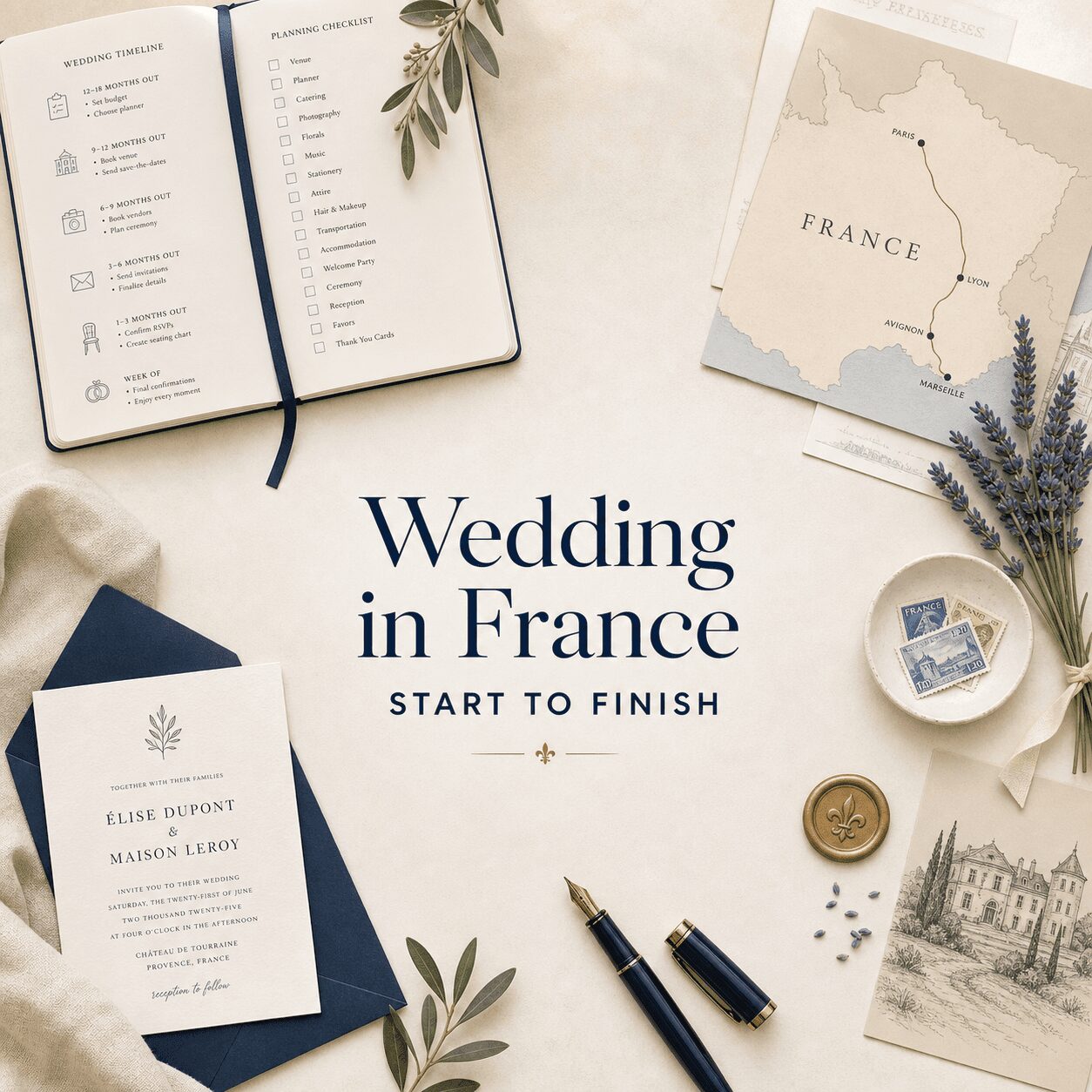
People talk about "a wedding in France" like it's a vibe. A long table. Warm light. Maybe a string quartet somewhere in the olive trees. And yes, sometimes it really is like that.
But if you are actually doing it—planning it, paying for it, getting everyone there, feeding them, sleeping them, keeping the timeline from melting—it's not just a vibe. It's a project. A beautiful one, sure. Still a project.
This is the real start to finish version. Not the fantasy. The thing that happens in your inbox, on WhatsApp, in spreadsheets, and in those odd moments where you suddenly remember you have to figure out transport from the airport for 27 people.
Step 1: Decide what kind of "France wedding" you mean (because there are a few)
Before you book anything, you need to answer one question:
Are you doing a legal wedding in France or a symbolic ceremony in France (and doing the legal part at home)?
This matters. A lot.
Option A: Legal marriage in France
This is possible, but for most international couples it gets complicated quickly. In France, civil marriage is done at the mairie (town hall), and the rules are strict. Usually you need residency ties to the commune, specific paperwork, sworn translations, and time. Sometimes it's doable but often it's stressful.
If you're considering this route, it's crucial to understand the wedding planning process in France.
Option B: Legal at home, ceremony in France
This is what most destination wedding couples do. You get legally married in your home country (even quietly at city hall), then you do the ceremony and celebration in France with your guests. You still get all the magic, and way less admin pressure.
If you're leaning towards this option and want to experience an intimate wedding venue in France, or perhaps even plan a romantic vineyard wedding in the South of France, there are resources available to help guide you through this process.
Furthermore, if you're looking to plan a more unique destination wedding—from Lyon to your chosen vineyard—consider exploring vendor networks for planning a wedding in France from abroad. This could open up new avenues for your dream wedding while ensuring everything runs smoothly on the ground.
Step 2: Pick a region that matches your guests, your budget, and your reality
France is not one thing. A wedding in Provence feels different from a wedding in the Alps, or the Loire, or Bordeaux, or Brittany.
And you do not just choose based on Pinterest. You choose based on:
- Nearest airports and trains
- Total travel time for your guests
- Seasonal weather (real weather, not "romantic" weather)
- Venue availability
- Cost levels in that region
- The kind of weekend you want: quiet countryside or tourist town energy
A practical sweet spot: Beaujolais
Beaujolais is one of those places that quietly makes a lot of sense for destination weddings. It's wine country, it's green, it's charming, and it's close to Lyon (major airport + train connections). And it still feels like "real France", not a theme park version of it.
If you are looking for a multi day private estate experience, this is where venues like Domaine de Vavril in Beaujeu come in. It's an 18th-century wine estate that you can fully privatize for weddings, with accommodation on site, gardens, a stone reception hall, and even a heated pool. Which sounds like a luxury add on until you realize how nice it is to have your people all in one place.
The Domaine de Vavril, not only offers a stunning venue but also provides insights into the seasonal guide for vineyard weddings in France, helping couples choose the perfect time for their big day.
Additionally, if you're considering an intimate gathering rather than a large wedding party, Vavril also offers weekend elopement packages which could provide the ideal solution.
Step 3: Choose your format (one day wedding vs wedding weekend)
This is the big fork in the road.
One day wedding
You book a venue, do ceremony, cocktail hour, dinner, party, guests leave. It's simpler. Usually cheaper. But if guests are flying in, it can feel rushed.
Wedding weekend
This is what most people envision when they think of a "destination wedding in France".
Common structure:
- Day 1: Welcome dinner or aperitif
- Day 2: Wedding day
- Day 3: Brunch and goodbye
It's slower. More social. More memorable. Also more planning. But it's the format where a private estate really shines, because you are not trying to squeeze everything into one evening.
Step 4: Budget properly (and yes, France has surprises)
People assume France is either wildly expensive or weirdly cheap. The truth is both. It depends on region, season, and how "all in" you go.
Your big cost buckets usually look like:
- Venue rental (often includes furniture, sometimes not)
- Catering (cocktail + dinner + late night food)
- Drinks package or open bar
- Accommodation (either included, partially, or separate)
- Planner or coordinator (highly recommended if you're abroad)
- Flowers and decor
- Photo and video
- Music (DJ or band)
- Transport (guest shuttles, vendor transport)
- Hair and makeup
- Paper goods, signage
- Welcome gifts and weekend extras
A hidden cost people forget: logistics. Not glamorous, but it adds up.
If you choose a venue where guests can stay on site and events can happen across multiple spaces (reception hall, gardens, outdoor areas), you cut down a lot of transport and timing problems. It's one reason venues like Vavril are built around full privatization. You are not sharing the property with random tourists. You can actually breathe.
Moreover, if you're planning your wedding from abroad, coordinating group transportation for rural destination events in France can be quite challenging but crucial for a smooth experience.
When it comes to the budget aspect of your wedding, understanding the complete budget guide for French vineyard wedding costs can provide valuable insights.
As for the venue itself, there are many sustainable wedding venues in French vineyards that offer both beauty and eco-friendliness.
And if you're considering an outdoor wedding reception in the vineyards, there are many unique ideas for such receptions that you might find inspiring.
Lastly, if you're an American planning an intimate French vineyard wedding, this guide on planning your intimate French vineyard wedding from America could prove to be extremely helpful.
Step 5: Book the venue early (because the good ones go fast)
If you're planning a destination wedding in France, it's crucial to book your venue early. Typically, you should aim for:
- 12 to 18 months ahead for peak season (May to September)
- 9 to 12 months for shoulder season
- Sometimes less for off season, but fewer vendors are available
When you talk to venues, it's essential to ask specific questions to ensure it meets your needs. Here are some key venue site tour questions you should consider:
- Is the venue exclusive or shared?
- How many guests can sleep on site?
- What's the indoor plan if it rains?
- What time does music need to stop?
- Are you required to use certain caterers?
- What is included in the rental price?
- How many days do you actually get access?
If your dream is a full weekend with everyone together, you want a place designed for that. Not a room rental that kicks you out at midnight. It's also essential to avoid common pitfalls when booking an exclusive use venue in France.

Step 6: Lock in your key vendors (planner first, if you're not in France)
This is where people either get smart or suffer.
If you live abroad, having a planner or at least a strong on-the-day coordinator is huge. Not because you can't plan. But because France has its own rhythm. Calls instead of emails. Vendors who disappear for August. Delivery windows. Local rules.
Your priority vendor list:
- Planner or coordinator
- Caterer
- Photographer
- Music (DJ or band)
- Florist and decor team
Then you add:
- Celebrant for the symbolic ceremony
- Hair and makeup
- Transportation company
- Rentals if needed (chairs, linens, lighting)
If you're considering a fall wedding, remember that harvest season weddings offer unique advantages in terms of scenery and availability of venues and vendors.
Step 7: Figure out guest experience early (not last minute)
Destination weddings work best when guests feel looked after.
A simple checklist to ensure their comfort includes:
- Closest airport and train station info
- Clear directions to the venue
- Suggested arrival day and departure day
- Transport options (rental cars vs shuttles)
- Accommodation plan (on-site rooms, nearby hotels, etc.)
- Dress code that matches the terrain (heels on grass is a classic mistake)
- Local tips: what to do, what to eat, what to see
If your venue offers on-site accommodation, like a luxury estate, you can build a whole weekend without scattering people across the region. That alone makes the experience feel more intimate, and honestly less chaotic.
Step 8: Plan the ceremony like you mean it
Even if it's symbolic, treat it seriously.
You need:
- Ceremony timing (watch the light, especially in summer)
- Seating and shade if outdoors
- Sound system if over 40 guests (people want to hear)
- A wet weather plan
- A processional plan (who walks when, where they stand, how long it takes)
- A short ceremony script that sounds like you, not like a generic poem
If you are on a wine estate in the countryside, the ceremony tends to be calmer, more grounded. Less "production", more actual emotion. That's usually what people want, even if they don't say it upfront.

Step 9: Design the wedding meal (France is not the place to be casual about food)
Let's be real. Food is part of the reason people come.
French wedding catering often follows a rhythm:
- Cocktail hour with passed bites and stations
- Sit down dinner with multiple courses
- Cheese course sometimes
- Dessert plus cake or a dessert table
- Late night snack (highly recommended)
Ask your caterer:
- Can they accommodate dietary needs without making it weird?
- Is staffing included?
- Are glassware and linens included?
- How long is the meal service, realistically?
Also, think about wine. If you're in a region like Beaujolais, it's almost a waste not to lean into local bottles. For more insights on organizing a destination wedding in this beautiful region, check out this ultimate checklist.
Step 10: The timeline (this is the part that decides whether you enjoy your own wedding)
Here's a realistic wedding day flow for a French countryside venue:
- 11:00 to 14:00: Getting ready, photos, lunch for the couple
- 15:30: Ceremony
- 16:15: Cocktail hour
- 18:30: Guests seated
- 19:00: Dinner begins
- 22:00: Dancing
- 00:30: Late night food
- 02:00: End (varies by venue rules)
Two keys:
- Build in buffer time. France runs a little slow sometimes. It's fine.
- Decide early how you want the evening to feel. Elegant dinner party? Full club energy? Somewhere in between?
If you're looking for ways to personalize your wedding ceremony in the French countryside, consider exploring these personalization options. And if you're still searching for that perfect venue, it's worth understanding the difference between authentic and commercial French wedding venues, or even considering some fairytale wedding venues in French vineyards.
Step 11: Weather plan (because it will rain the one time you assume it won't)
Even in summer.
A strong venue will have:
- A real indoor reception space that doesn't feel like a backup
- Covered areas for cocktail hour
- A plan for ceremony relocation
- Heating options for cooler nights, especially shoulder season
This is where stone reception halls and flexible indoor spaces make a difference. You are not "settling" for indoors. You're just switching the vibe.
Step 12: The final week (and the part nobody posts about)
The final week is usually:
- Guest messages and minor emergencies
- Vendor confirmations
- Seating chart tweaks
- Weather checking every hour, even though you promised you wouldn't
- Packing details you never imagined caring about (tape, steamer, extension cords)
If you can arrive two or three days early, do it. Walk the venue. Taste the wine. Get your bearings. The calm you buy yourself is worth it. Speaking of tasting wine, consider arranging wine tours for your wedding guests. It could be a delightful experience for them.
Step 13: The wedding weekend itself (this is why you did it)
Then it happens.
People arrive. They hug longer than usual because they traveled for you. The welcome dinner turns into a loud, happy mess. The wedding day goes by too fast. Someone cries during the vows. Someone else cries during the speeches. The dance floor gets warm. The next morning everyone looks a little sunburnt and sleepy at brunch.
And you realize the whole point of doing it in France was not just the scenery.
It was the time. The togetherness. The way the weekend forces everyone to slow down.

A quick note if you're venue shopping right now
If your goal is a wedding that feels private, unhurried, and genuinely French, look for venues that are built for multi-day events. Not just a pretty room.
Domaine de Vavril (Vavril) is one of those rare places that's set up for the full experience. A renovated 18th-century wine estate in Beaujeu, in the Beaujolais region, with a stone reception hall, gardens, on-site accommodation, and full privatization so the weekend is actually yours.
You can explore the venue and request availability here: Domaine de Vavril
The simplest way to think about it
A wedding in France is not hard because France is hard.
It's hard because it's a big thing, far from home, with moving parts.
But if you choose the right region, book a venue like Vavril that supports a full weekend and offers an authentic French vineyard wedding experience, and treat logistics as part of the romance rather than an obstacle, it becomes… honestly, kind of incredible.
And yeah. It looks good in photos too. But that's not the best part.
For those curious about what to expect at a French vineyard wedding, or wanting to understand some French wedding traditions, Vavril provides a wealth of information.
FAQs (Frequently Asked Questions)
What are the main options for having a wedding in France?
You can either have a legal marriage in France, which involves strict rules, residency ties, and specific paperwork at the mairie (town hall), or you can have a symbolic ceremony in France while completing the legal marriage in your home country. Most destination wedding couples choose the latter to avoid administrative stress.
Why is it important to decide between a legal wedding and a symbolic ceremony in France?
Because the legal requirements for marriage in France are strict and often complicated for international couples, deciding upfront whether you want a legal wedding there or just a symbolic ceremony helps streamline planning and ensures you meet all necessary criteria without surprises.
How should I choose the region in France for my wedding?
Consider practical factors such as nearest airports and train stations, total travel time for your guests, seasonal weather, venue availability, cost levels in that region, and the kind of atmosphere you want—whether it's quiet countryside or lively tourist towns. Regions like Beaujolais offer a charming balance with good transport links and authentic French ambiance.
What makes Beaujolais a practical choice for a destination wedding in France?
Beaujolais is wine country with lush greenery and charm, close to Lyon's major airport and train connections. It offers authentic 'real France' vibes rather than touristy themes. Venues like Domaine de Vavril provide private estates with accommodations on-site, gardens, reception halls, and even heated pools—ideal for multi-day weddings.
What are the differences between a one-day wedding and a wedding weekend in France?
A one-day wedding involves booking a venue for ceremony, cocktail hour, dinner, and party all on the same day—simpler and usually cheaper but can feel rushed if guests are flying in. A wedding weekend spreads events over multiple days (welcome dinner on Day 1, main events on Day 2), allowing more relaxed celebrations especially suited for destination weddings.
Are there resources available to help plan an intimate or vineyard wedding in France?
Yes! There are specialized resources and vendor networks that guide couples through planning intimate weddings or romantic vineyard weddings in regions like South of France. Venues such as Domaine de Vavril also offer weekend elopement packages perfect for smaller gatherings while ensuring smooth logistics from abroad.