
Booking a French Venue Without Visiting: Is It Ever a Good Idea?
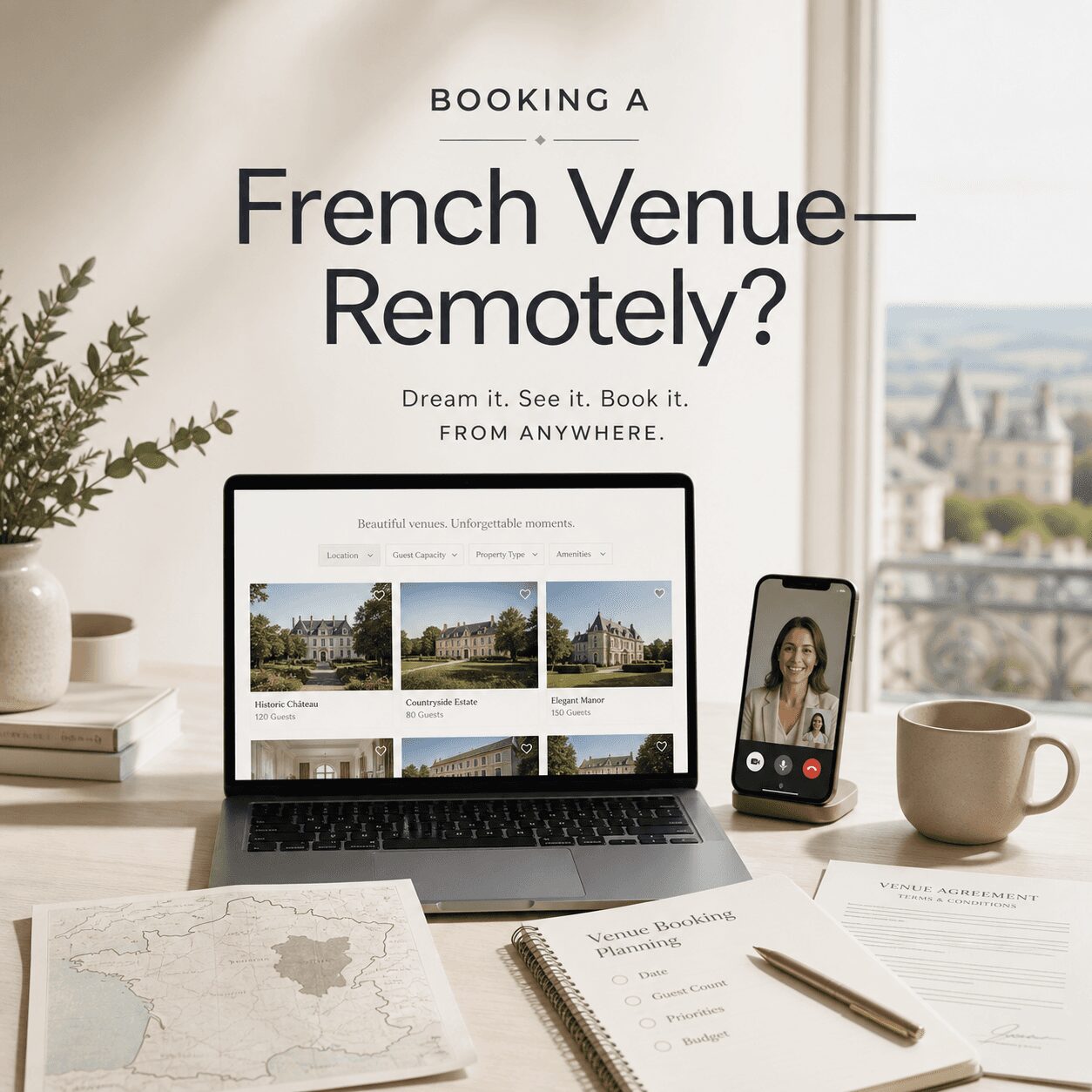
If you're planning a wedding or a big family weekend in France, there's a moment where you catch yourself doing something slightly insane.
You're zoomed in on Google Maps. You've got 37 tabs open. You're watching an Instagram Reel of fairy lights in a stone courtyard and thinking, yep. This is it. Book it.
And then the sensible part of your brain clears its throat.
Wait. Are we really about to book a venue in another country… without ever stepping foot on it?
It's a real question now because destination events are normal. Couples live in London, New York, Dubai, Singapore. Family groups are spread out across five time zones. Work schedules are chaotic. And a quick weekend "venue tour" can turn into a full travel mission with flights, hotels, car rental, childcare, time off.
So. Is booking a French venue without visiting ever a good idea?
Sometimes, yes.
But only if you do it with your eyes open, and you set up the right checks so you do not end up with a beautiful website and a stressful reality.

The honest answer: it depends on the type of venue (and the type of event)
A one day city hotel ballroom is one thing. A multi day private estate in the countryside is another.
When a venue includes accommodation, multiple event spaces, outdoor areas, a pool, and you're essentially "moving in" with your guests for a few days, the stakes go up. Not because it's risky by default, but because there are more variables.
For example, booking an exclusive use venue like Domaine de Vavril in Beaujolais is not just about room rental; it's about experiencing the whole property. It's about the setting, the flow of the weekend, and how your guests interact with various spaces throughout their stay. Such exclusive-use venues can absolutely be booked remotely if done correctly.
However, when considering such significant decisions like choosing an intimate wedding venue abroad or understanding what makes Domaine de Vavril unique among French estates, it becomes essential to have comprehensive knowledge and clarity on several aspects.
Moreover, it's crucial to have a complete budget guide at hand when planning such events as costs can vary greatly depending on numerous factors.
Why people skip the visit (and why it's not always a red flag)
Let's normalize it a bit. Not visiting doesn't automatically mean you're careless.
Common reasons:
- You're planning from abroad, and flights are expensive.
- You have limited vacation days, and you'd rather use them for the actual event.
- You're coordinating with family and it's hard to get decision makers in the same place.
- You fell in love with a very specific region, and you're confident about the vibe (like Beaujolais, Provence, Dordogne).
- You're booking far in advance and you want to secure dates quickly.
Also, some venues are simply set up for it. They have clear documentation, responsive communication, transparent contracts, good third party reviews, and they know how to host international clients who cannot pop in for a quick tour.
That last part matters more than people think.
The biggest risk is not "scam". It's mismatch
Most of the time, the fear isn't actually fraud. It's the subtle mismatch between expectation and reality.
Like:
- The "garden ceremony spot" is gorgeous, but it's right next to a road you didn't notice in photos.
- The reception hall is beautiful, but the acoustics are echoey and the dance floor feels cramped.
- The bedrooms are charming, but one wing is much more modern than the other, and your group cares about that.
- The property is peaceful, but the nearest bakery is 18 minutes away and you've got guests who panic without coffee.
A venue can be legitimate, well run, and still not be right for your event.
Remote booking can work. The goal is to reduce mismatch.
When considering venues for a wedding in France, it's crucial to distinguish between authentic vs commercial French wedding venues. For those dreaming of an intimate celebration, micro weddings in French vineyards could be the perfect solution. If you're enchanted by fairy-tale settings, exploring fairytale wedding venues in French vineyards might offer some inspiration. Additionally, if sustainability is important to you, consider looking into sustainable wedding venues in French vineyards, which can provide both charm and eco-friendliness.
When booking without visiting is actually a good idea
Here are situations where I'd say yes, it can be a genuinely good idea.
1. The venue offers full privatization and clear boundaries
If you're booking an estate and it's clearly defined what you get, and what you do not get, it's easier to plan remotely. Full privatization typically means no surprise "other guests" wandering around and no shared spaces to negotiate.
This is one reason estates like Vavril, marketed as a fully privatized multi-day venue, appeal to destination weddings and group celebrations. You're not trying to picture how your event fits around other bookings. It's yours.
2. You can do a proper live video tour, not a rushed phone call
A real video tour is not someone spinning their phone around for 3 minutes while the wind destroys the audio. A proper tour includes aspects like walking the guest arrival route, showing realistic parking options, demonstrating indoor plan B spaces for bad weather, and more. If a venue is willing to provide such a thorough virtual tour, it's a very good sign.
3. You're flexible on small details but care about the big feeling
If you're the kind of planner who needs every centimeter mapped out before booking, remote booking will feel stressful.
But if you care about overall atmosphere, privacy, comfort, flow of a weekend, and you can accept that some small things are learned later, you'll do better.
For those considering an elopement, especially in picturesque locations like the French wine country, budget-friendly elopement ideas offered by Vavril could be worth exploring.
4. The venue has a track record of hosting international events
This one's underrated. It's not just about speaking English. It's about understanding the questions international couples ask, the way timelines work for destination weddings, and what information people need when they cannot physically inspect the property.
Look for testimonials, real wedding albums, and planning content that shows they've done this before. For instance, Vavril, a venue that specializes in hosting weddings for international couples, shares photo albums and venue info oriented around actual events. This helps a lot when you're trying to picture it from afar.
When you should not book without visiting
Now the flip side, because sometimes the answer is simply no.
1. You're extremely sensitive to comfort standards
If you know your family will complain about mattresses, bathroom layouts, stairs, room sizes, or temperature control, seeing it in person can save you.
Photos can be honest and still not communicate "feel".
2. You have guests with accessibility needs
Old estates in France are often full of charm and also… stairs. Uneven stone. Thresholds. Garden paths. If accessibility matters, you need specific measurements and a careful walkthrough, ideally with video plus written confirmation.
3. You're booking a venue that is vague or evasive
If answers are slow, contracts are unclear, or you can't get direct confirmation about basics (noise rules, end times, accommodation count, pool safety rules, deposit terms), do not book remotely. Honestly, maybe do not book at all.
4. You're planning peak season with zero weather flexibility
If the dream is an outdoor dinner, outdoor ceremony, outdoor dancing, and you don't like the indoor options… you should see it. Rain plan matters in France. Even in summer.

A simple remote booking checklist (the one people skip, then regret)
If you're going to book without visiting, do it like a professional.
Ask for:
1. A full photo set, not just highlights
You want boring photos too. Parking. Bathrooms. Hall corners. Catering entrance. The less romantic stuff.
2. A floor plan or at least a basic layout diagram
Even a simple PDF is helpful. Where do people sleep, eat, gather, dance, recover.
3. A recent video walkthrough
Recent matters. Properties evolve.
4. Capacity details in plain language
Not "up to 120". Ask: 120 seated dinner indoors with dance floor, yes or no? What does it look like?
5. Exact accommodation count by room type
How many rooms, how many beds, how many bathrooms, and whether beds can be configured.
6. Supplier rules
Can you bring your own caterer? Are there recommended partners? Corkage fees? Kitchen use? Music rules?
7. Noise and curfew rules
This can make or break a wedding weekend.
8. A contract you can read calmly
Deposits, payment schedule, cancellation terms, force majeure, damage deposit, pool safety, insurance.
And then do this:
Get someone else to read your contract.
Not because it's suspicious. Because planning makes you emotionally blind. A second set of eyes catches obvious things.
The "send a friend" option (a nice middle ground)
If you cannot visit but you're nervous, consider sending a local friend or even hiring a local wedding planner to do a site visit on your behalf. Hiring a French wedding planner can be particularly beneficial as they know the local landscape and can provide valuable insights.
Ask them to:
- record wide angle video, slow walk through
- test phone reception in key spots
- check travel time from nearest train station
- look for any nearby noise sources (roads, cafés, church bells, farms)
- take realistic bedroom photos
This is not overkill; it's cheaper than regret.
Also remember that if you're considering a vineyard as your wedding venue in France, there are specific checklist items to look for that can help ensure it's the right fit for your special day.
Lastly, understanding French wedding traditions can also enrich your experience and help you blend personal preferences with local customs.
A quick note on Beaujolais as a region (because it helps your decision)
Beaujolais is one of those areas that quietly makes sense for destination events. It's wine country, but not as crowded as some of the big famous regions. You've got beautiful rolling landscapes, stone villages, and it's relatively accessible via Lyon. That combination is gold for international groups.
So if you're looking at an estate in Beaujolais, the region itself is doing part of the work. Guests get a real French countryside experience without feeling totally remote from airports and trains.
That's part of the appeal of places like Domaine de Vavril, an 18th century renovated wine estate set up for multi-day private events, with reception spaces, gardens, and on-site accommodation. It fits the destination wedding weekend format very naturally.
So… is it ever a good idea?
Yes. Booking a French venue without visiting can be a very good idea when the venue is transparent, experienced, and set up for remote planning. And when you do your homework properly.
The bad version is booking based on vibes and two pretty photos. The good version is booking remotely with evidence – video tours, layout plans, clear answers to your questions, a contract you understand, a realistic plan B for weather contingencies, and ideally, a venue that has already hosted people exactly like you.
If you're currently in that research spiral, start by narrowing down venues that make remote decision making easy. Look for clear information, responsive communication, real event albums showcasing previous weddings, and a straightforward booking process.
And if you want to see what that looks like in practice, Vavril's website serves as an excellent reference even if you're still comparing options. It demonstrates the kind of detail and event-focused presentation you should be looking for when you cannot visit in person.
If you're considering hosting an intimate wedding in France's picturesque vineyards while planning from afar or personalizing your ceremony to reflect your unique style amidst the stunning scenery of the French countryside, Vavril's guide on planning your vineyard wedding from America could provide valuable insights.
For couples from the UK contemplating a vineyard wedding over a traditional chateau setting, this article offers practical advice tailored to your needs. Additionally, if you're curious about how to infuse personal touches into your wedding ceremony while embracing the charm of the French countryside, this resource could serve as an excellent guide.
In summary, Beaujolais offers not just stunning scenery but also the potential for memorable destination events such as weddings. With venues like Domaine de Vavril leading the way in providing seamless remote planning experiences and personalized services tailored to individual preferences.
One last thing (because people forget this too)
Even if you do visit, you're usually seeing the venue on a random weekday at a random time, with perfect calm.
So visiting is helpful, yes. But it's not magic.
Remote booking done properly can be just as safe. Sometimes safer, because you're forced to ask better questions and get things in writing.
That's the real win. Not the plane ticket.
FAQs (Frequently Asked Questions)
Is it advisable to book a French wedding venue without visiting it first?
Booking a French wedding venue remotely can be a good idea, especially for destination events where travel logistics are complex. However, it's crucial to proceed with eyes wide open, ensuring you have comprehensive knowledge about the venue and setting up the right checks to avoid surprises. This approach works best when the venue offers clear documentation, transparent contracts, responsive communication, and positive third-party reviews.
What types of venues are more suitable for remote booking in France?
Venues like one-day city hotel ballrooms are simpler and generally easier to book remotely. Exclusive-use private estates in the countryside—such as Domaine de Vavril in Beaujolais—can also be booked remotely if done correctly, though they involve more variables like accommodation, multiple event spaces, and outdoor areas. The stakes are higher for multi-day events with guests staying on-site, so thorough research is essential.
Why do some couples choose not to visit their French wedding venue before booking?
Common reasons include expensive flights when planning from abroad, limited vacation days reserved for the event itself, coordinating with family across time zones, confidence in a specific region's vibe (like Beaujolais or Provence), and the need to secure dates far in advance. Additionally, some venues are well-equipped to accommodate international clients who cannot visit beforehand.
What are the biggest risks involved in booking a French wedding venue remotely?
The main risk is not fraud but a mismatch between expectations and reality. For example, a beautiful garden ceremony spot might be adjacent to a noisy road; reception halls may have poor acoustics; accommodations might vary in style; or local amenities like bakeries could be far away. Ensuring alignment between your event needs and the venue's actual features is key to minimizing this risk.
How can I reduce mismatches when booking an intimate wedding venue in France remotely?
To reduce mismatches, seek authentic rather than commercial venues, review detailed photos and videos, ask for virtual tours if possible, read third-party reviews carefully, clarify all contract terms transparently, and ensure open communication with venue managers experienced in hosting international clients. Having a complete budget guide also helps manage expectations regarding costs.
What resources can help me plan a sustainable and authentic micro wedding at a French vineyard?
Exploring guides on micro weddings in French vineyards can offer valuable insights into intimate celebrations that emphasize authenticity and sustainability. Resources detailing fairytale wedding venues within French vineyards provide inspiration for enchanting settings. Additionally, understanding the differences between authentic and commercial venues will support making eco-friendly choices aligned with your values.