
All-Inclusive vs À La Carte French Wedding Venues: The Real Difference
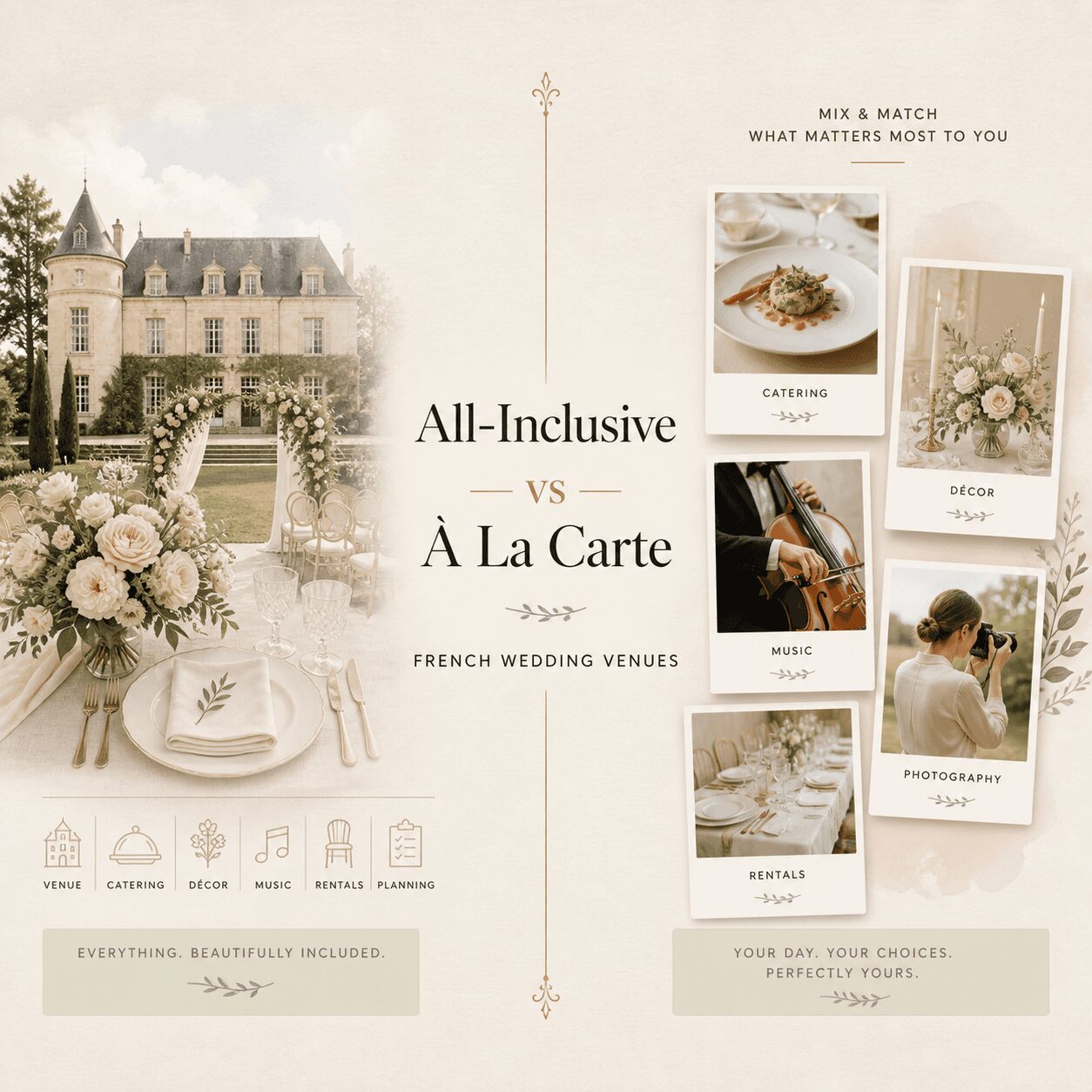
Planning a wedding in France is one of those ideas that starts out as a daydream. Vineyard views. Long tables. Sunset photos that look a little too perfect.
Then you actually start planning and you hit the first big decision that quietly decides everything else.
Do we book an all-inclusive French wedding venue… or do we go à la carte?
People talk about it like it's just a budget question. It's not. It's a control question. A stress question. A "how do we want this to feel for us and our guests for three days" question.
And in France, where venues can range from "here are the keys, good luck" to "we'll handle almost everything," the difference is real. Sometimes subtle. Sometimes massive.
So let's break it down properly. Not in a salesy way. In the way you actually need when you're comparing venues, emailing ten different people, and trying to picture how it will all run on the day.

First, what does "all-inclusive" really mean in France?
In wedding-land, "all-inclusive" can mean a few different things, and this is where couples get tripped up.
Some venues mean:
- Venue + furniture + staff + catering + bar + coordination + accommodation. Full package.
- Venue + a required list of partner vendors (caterer, DJ, planner) and they manage the handoffs.
- Venue + "we can recommend people" (this is not all-inclusive, even if they say it is).
A true all-inclusive setup usually includes the essentials already bundled, with a clear point person, and fewer decisions left hanging.
But here's the catch. In France, many venues are not fully all-inclusive in the way some UK or US couples imagine. A lot of French estates are closer to "exclusive hire" venues where you're renting the property often for a weekend and bringing in your own team. This scenario is where à la carte options come into play.
However, if you're leaning towards an all-inclusive option but still want to enjoy the charm of French vineyards, there are fairytale wedding venues in French vineyards that offer such packages.
For those who have sustainability in mind while planning their big day, exploring sustainable wedding venues in French vineyards could be an excellent choice.
Lastly, if luxury is what you're after, there are French vineyard wedding venues known for luxury experiences that could provide the opulence you desire while still being all-inclusive.
And what does "à la carte" actually look like?
À la carte venues are usually about freedom and flexibility.
You book the location and the accommodation (sometimes optional, sometimes required). Then you choose:
- Caterer
- Planner or coordinator
- Florist
- Rentals (chairs, tables, linens, tableware)
- DJ or band
- Photographer
- Transport
- Brunch provider
- Babysitters
- Welcome dinner setup
- Late-night food
- Anything else you want
Which sounds fun. It can be. But it's also a lot of moving parts, especially if you're planning from abroad. Choosing the perfect wedding venue abroad can alleviate some of this stress.
The real differences (the ones that matter)
Let's get practical. These are the differences you feel in your inbox, your budget sheet, and your stress levels.
1) Who is actually in charge on the wedding weekend?
All-inclusive: there's usually one operations lead. They know the timings, the staff, the rules, the plan B if it rains. You're not coordinating 12 separate vendors yourself.
À la carte: you need someone to be the "conductor." That can be you, your planner, or sometimes a day-of coordinator you hire separately. Without that, things get… wobbly. Especially on a multi-day wedding.
A lot of couples don't realize this until they're already locked in. They assume "the venue will handle it." Some will. Many won't.
So ask directly: Who is present on site during setup and on the wedding day? And what do they handle?
These questions become even more crucial when considering a vineyard wedding venue, where specific logistics and arrangements may require extra attention.
2) The budget feels clearer, or it doesn't
All-inclusive: you get one number (or a small set of numbers). It's easier to compare at first glance. It's also easier to understand what your minimum spend is.
À la carte: you'll often think you're saving money at the start because the venue hire looks "reasonable." Then you build the real total:
- Rentals
- Transport costs for vendors
- Extra lighting
- Staff you didn't know you needed
- Cleanup fees
- Generator (yes, sometimes)
- Corkage, cake cutting, glassware hire
- Overtime charges
And suddenly the venue hire was the smallest line on the sheet.
Not always, but often.
A good à la carte venue can still be cost-effective. It just requires tighter planning and fewer surprises. Alternatively, if you're looking for a more budget-friendly option, consider exploring these elopement ideas in French wine country.
3) You get freedom, but you also get decision fatigue
All-inclusive: fewer decisions. You'll have options, but they're curated. Which can feel like a relief.
À la carte: you can choose everything. Your dream caterer, your dream chairs, your exact shade of linen. It's great if you love planning. Or if you have a planner. If not, it can turn into death by a thousand PDFs.
A simple test: if you already feel tired picking a wedding website template… à la carte might be a lot.

4) Vendor flexibility vs vendor restrictions
This is a significant factor to consider when planning a wedding in France.
Certain all-inclusive venues may require you to use their in-house caterer, bar, and staff. While this can sometimes be beneficial, especially if their services are top-notch, it can also be restrictive. This is particularly true for cultural weddings that require different cuisines, schedules, or ceremony formats.
On the other hand, à la carte venues typically allow you to bring in your preferred vendors. However, they might impose certain constraints such as:
- Approved vendor lists (for insurance or quality control)
- Noise curfews
- No open flames
- Setup time windows
- Mandatory security after a certain hour
- Limits on guest count or parking
None of these restrictions are inherently negative; they just need to be understood early in the planning process rather than being discovered two months before the wedding.
5) Guest experience over multiple days
For those considering a destination wedding in France, it's important to note that the event often extends beyond just one day. Typically, it includes:
- Welcome dinner
- Wedding day
- Next-day brunch or pool day
All-inclusive venues tend to facilitate a smoother experience for multi-day events as they are accustomed to hosting such occasions and have already incorporated seamless transitions between events into their workflow.
Conversely, while it's entirely possible to execute a multi-day event beautifully at an à la carte venue, several logistical aspects need careful consideration. These include:
- Where will the welcome dinner take place?
- Who will provide the food and staff for that evening?
- Who is responsible for clearing up afterwards?
- What time can vendors arrive the following day?
- Are guests permitted to use the pool? If so, when and who will supervise?
- Is there sufficient accommodation on-site or will shuttles be required?
The last point often holds more significance than couples anticipate. Venues that offer on-site accommodation and have adequate space for hosting multiple events can transform destination weddings into an immersive experience akin to a little village for the weekend. Guests can settle in, relax and connect with one another.
This aspect is one of the reasons why private estates in regions like Beaujolais are increasingly popular among international couples. Such estates often provide not only stunning scenery but also the flexibility of hosting various types of weddings including micro-weddings or even spring weddings which are quite common in these regions.
Additionally, for couples considering a weekend elopement in France or Italy, understanding these aspects can greatly enhance their overall experience.
The hidden question: are you booking a "venue" or a "basecamp"?
Some French wedding venues are basically event halls with pretty surroundings. Others, however, are more than just a venue. They serve as a full estate. These estates come with gardens, stone buildings, accommodation, places to gather, places to disappear for a minute, and enough privacy that you're not worrying about neighbors every time someone laughs too loud.
If your vision includes a whole weekend and not just a ceremony and dinner, you want a basecamp. This is where places like the Domaine de Vavril, located in Beaujolais, tend to stand out. It's positioned as a fully privatized, multi-day estate with reception spaces and on-site accommodation. That "we have the keys to the whole place" feeling changes the mood for everyone.
If you're curious what that looks like in practice, you can browse the estate and spaces here: https://vavril.fr.
Pros and cons, honestly
All-inclusive French wedding venues: the good
- Faster planning timeline
- Fewer vendors to source and manage
- More predictable flow on the day
- Clearer staffing and logistics
- Often easier for couples planning from abroad
All-inclusive: the not so good
- Less flexibility (sometimes)
- Costs can be higher, or at least feel less customizable
- Package options may not match your culture or your vibe
- You can end up paying for things you don't care about
À la carte venues: the good
- Full creative control
- You can prioritize what matters to you (food, music, design)
- Potentially better value if you plan carefully
- Easier to incorporate specific traditions or cuisines like those explained in our article about French wedding traditions
However, it's important to understand that each type of venue has its own set of advantages and disadvantages. For example, while an all-inclusive venue might offer convenience and predictability, it may also come with less flexibility and higher costs. On the other hand, an à la carte venue provides full creative control but requires more effort in planning.
It's worth noting that estate-style weddings like those offered at Domaine de Vavril often strike a balance between these two options. They provide the convenience of an all-inclusive package while still allowing for customization and personal touches.
Finally, if you're considering hosting your wedding at a luxury estate such as Domaine de Vavril, it's possible to plan a [sustainable wedding](https://vavril.fr/en/how-to-plan-a-sustainable-wedding-at-a-luxury-estate/) that aligns with your values while still being elegant and memorable.
À la carte: the not so good
- More planning labor, even with a planner
- More vendors means more coordination and risk
- Budget can creep quietly
- You need to understand French wedding logistics (deliveries, timing, staffing laws, noise rules)
How to choose (a simple decision framework)
Instead of asking "which is better," consider these questions.
1) How far away are we planning from?
If you're abroad and can't do multiple site visits, an all-inclusive elopement package in French wine country or "semi-inclusive with strong coordination" usually wins.
2) Do we have a planner?
If no planner, à la carte is still possible, but choose a venue that is used to destination weddings and has strong on-site support, clear documentation, and real recommendations. If you're considering hiring a local expert, find out if hiring a French wedding planner is really worth it.
If yes planner, à la carte becomes much easier and honestly kind of fun.
3) What do we care about most?
- Food obsessed: à la carte can be amazing.
- Stress allergic: all-inclusive.
- Design obsessed: à la carte.
- Want a relaxed three-day hang with friends: estate-style venues with accommodation, either model, but you need privacy and space.
4) What's our tolerance for logistics?
This is the real one.
Some couples love spreadsheets. Some couples want to show up and get married and drink wine and not think about chair delivery times. Be honest.
For those who prefer the latter option, an elopement in the French wine country could be a great choice.
And if you're unsure about how to pair your wedding details with the exquisite local offerings, consider exploring our French wine and wedding pairing guide.
Lastly, for some real-life inspiration, don't miss out on these US couples' stories of their real weddings at French vineyards.
Questions to ask venues (copy and paste these)
Whether it's all-inclusive or à la carte, ask:
- Is the venue exclusive hire? Are there other guests or events on site?
- What is included in the venue fee, exactly? Furniture, tables, chairs, lighting, sound basics?
- What time can suppliers access the venue for setup? And when do they have to leave?
- Is there an on-site coordinator? What do they do, and what don't they do?
- What are the noise rules and curfew? Indoors vs outdoors?
- What is the plan B for rain? Where does the ceremony move to?
- How many guests can sleep on site? And where do the rest stay?
- Are there restrictions on caterers, alcohol, fireworks, confetti, candles?
- Is there a next-day option (brunch, pool access, late checkout)?
- What are the cleaning expectations and fees?
A venue that answers these clearly is usually a venue that runs events well.
A quick note on "French style" vs "destination style"
Sometimes couples want a wedding that feels very French. Long aperitif. Late dinner. Dancing until very late. Local wines. Simple flowers. Stone walls. Warm lighting.
Sometimes they want a destination wedding that mixes cultures. Maybe a Western ceremony plus a second ceremony. Maybe a different menu. Maybe a different pacing.
Neither is better. But not every all-inclusive package is built for that flexibility, and not every à la carte venue is structured enough to make it easy.
So when you're looking at venues in places like Beaujolais, it can help to find estates that already market themselves to international couples, with English information and destination wedding experience baked in.
(Again, this is where Vavril's English section and wedding focused content can be handy if you're starting research: Vavril)
For those considering a wedding in France, understanding the nuances of French style weddings versus destination style weddings can be beneficial. Both styles have their unique charm but require different planning approaches.
If you're leaning towards a more intimate setting with a touch of elegance, choosing a French vineyard over a château wedding could be the perfect choice.
The bottom line
All-inclusive venues are about ease. You're buying simplicity, coordination, and fewer unknowns.
À la carte venues are about freedom. You're buying a beautiful setting and the right to build your own wedding world inside it.
The mistake is picking based on a headline price or a vague promise like "we're flexible." The real difference shows up later, in the fine print, in the supplier access times, in who is actually on site when a storm rolls in, and in whether you're spending your wedding morning answering texts.
If you want a wedding weekend that feels private and lived-in, like everyone has space to breathe and stay together, start your search with venues that are set up for multi-day exclusive hire. Estates, not just event rooms. For instance, consider exploring some exclusive vineyard venues near Geneva, which often provide the perfect blend of privacy and charm.
And if you're currently building a shortlist in Beaujolais, it's worth taking a look at Domaine de Vavril and seeing if the spaces and accommodation match your vision. Photos, details, and contact info are here: https://vavril.fr
FAQs (Frequently Asked Questions)
What does 'all-inclusive' mean for a French wedding venue?
In France, 'all-inclusive' wedding venues typically bundle the venue, furniture, staff, catering, bar, coordination, and accommodation into one package. However, the level of inclusivity varies—some venues require you to use their partner vendors while others only recommend vendors without full management. True all-inclusive venues provide a clear point person and handle most details to reduce stress.
How does an 'à la carte' wedding venue work in France?
'À la carte' venues offer freedom and flexibility by allowing you to rent the location (and sometimes accommodation) and then choose your own caterer, planner, florist, rentals, entertainment, photographer, transport, and other services. This approach means more control but also requires managing many moving parts, which can be challenging especially when planning from abroad.
What are the main differences between all-inclusive and à la carte wedding venues in France?
The key differences include who manages the wedding weekend (all-inclusive venues usually have an operations lead handling logistics), budget clarity (all-inclusive offers a clear total cost while à la carte requires adding up multiple vendor expenses), and stress levels (all-inclusive reduces vendor coordination stress whereas à la carte demands more hands-on planning).
Who is responsible for coordinating the wedding day at French venues?
At all-inclusive venues, there is typically one operations lead who oversees timings, staff, rules, and contingency plans. For à la carte weddings, you need a 'conductor' such as yourself, your planner, or a day-of coordinator to manage multiple vendors and ensure smooth execution throughout the event.
Are there special considerations for vineyard wedding venues in France?
Yes. Vineyard venues often involve unique logistics that require extra attention. When choosing a vineyard venue—whether all-inclusive or à la carte—it's important to ask about onsite coordination during setup and the wedding day to ensure seamless management of these specific arrangements.
How can I choose between an all-inclusive or à la carte French wedding venue?
Consider your priorities: if you want less stress with clear budgeting and a single point of contact managing everything on-site, an all-inclusive venue might be best. If you prefer flexibility to select each vendor yourself and enjoy creative control—but are prepared for more planning work—then an à la carte option suits you. Also evaluate your comfort with coordination and whether you'll hire a planner or coordinator.