
Private Estate vs Hotel Wedding in France: Pros, Cons, Cost
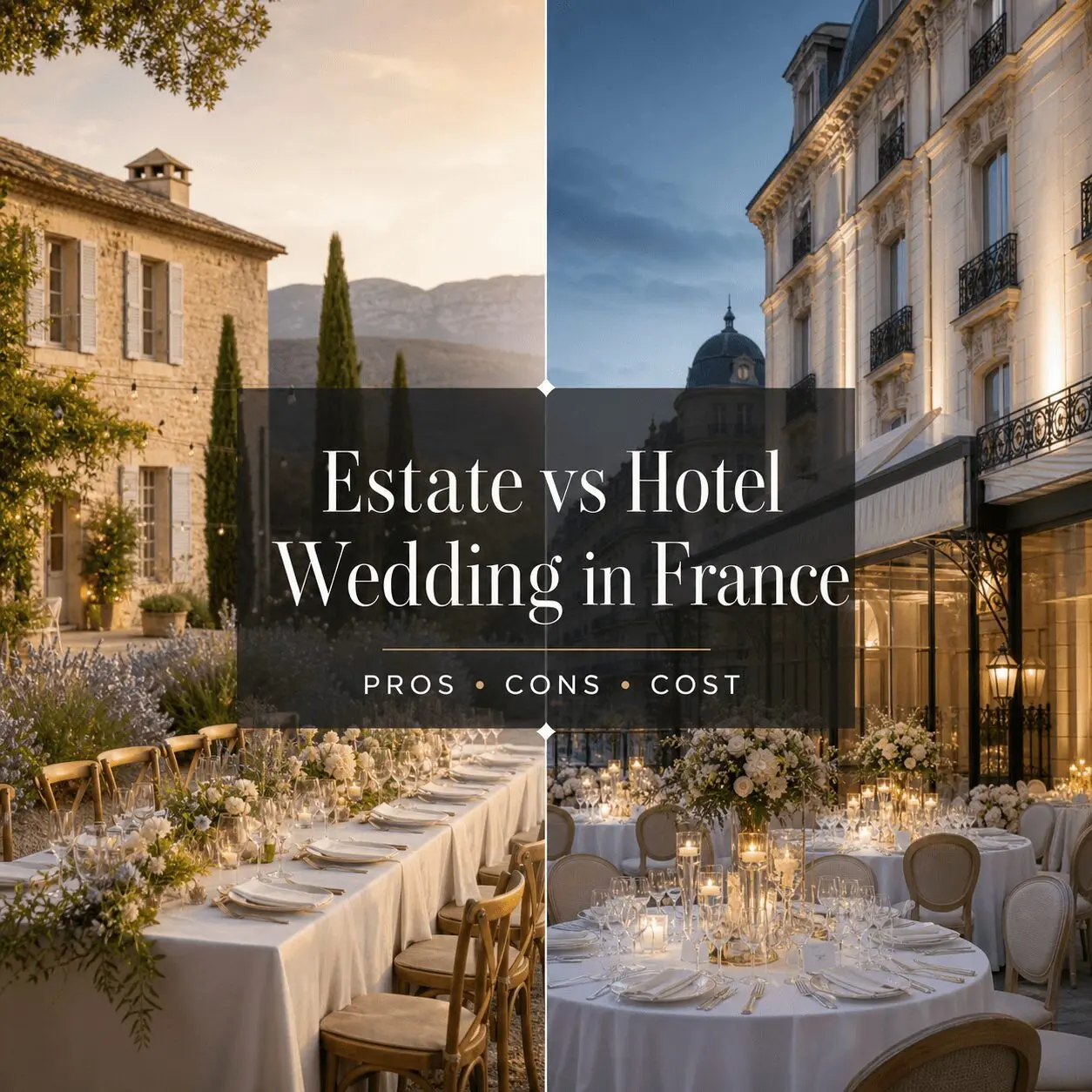
Planning a wedding in France when you don't live here (or even when you live in Paris and dream of fresh air) can feel both exciting and overwhelming.
The first real decision, the one that sets everything else in motion, is often this one: do you get married in a hotel or at a private estate? Both options can be stunning, but they can also make your life harder or, on the contrary, much easier. It depends on your style, your budget, and how comfortable you are with "we'll figure it out."
In this article, I compare the two options point by point. With realistic cost ranges, advantages that go beyond "it's pretty," and drawbacks people sometimes discover too late.
The choice in one sentence (if you're in a hurry)
- Hotel wedding: more "turnkey," with structured logistics, but often less private, less flexible, and the bill can climb very quickly on catering and rooms.
- Private estate wedding: more intimate, more customizable, more immersive (you actually stay on site), but you need to be okay managing a few vendors and reading the terms carefully. You could consider planning an intimate French vineyard wedding from America, which could offer a one-of-a-kind experience.
If you go for a wedding at a private estate, it can also offer more privacy and personalization. However, it does require some vendor management.
Okay. Now let's get into it for real.
What exactly we're comparing
Because people sometimes mix everything up.
When I say hotel, I mean an establishment with rooms, a restaurant or in-house kitchen, hotel service, and event spaces.
When I say private estate (domaine privé), I mean a venue reserved exclusively for your wedding, often with reception rooms, outdoor areas, sometimes a pool, sometimes on-site accommodation, and a list of partners (caterer, DJ, etc.), but not always "in-house" catering.
A typical example of an estate you can book for exclusive use is Domaine de Vavril, in Beaujolais. The venue is designed for weddings and group stays, with reception spaces, gardens and on-site accommodation. If you want to see what full exclusive use looks like, their website gives you a good idea.
1) The vibe: "wedding weekend" vs "hotel event"
Private estate: the bubble effect (and it's powerful)
The big advantage of an estate like Domaine de Vavril is the immersion. You arrive, you drop your bags, and your wedding becomes a little world of its own.
Often, the plan looks like this:
- a welcome party on Friday night (simple, but warm),
- the ceremony and party on Saturday,
- a brunch on Sunday.
And everyone gets the rhythm. Conversations last longer. People bump into each other at breakfast. There's less "we're heading back, see you tomorrow." It changes the energy.
Hotel: more urban, more structured, sometimes less intimate
A hotel is chic, practical and sometimes spectacular. But even with a gorgeous room, you're still in a place that runs for other guests too. So you may get:
- shared spaces,
- restrictions on moving around,
- a feeling that's a little less "our place."
That may be exactly what you want, especially if you like more of an "elegant dinner" vibe and less of a "whole weekend together" one.
2) Exclusive use: who's really at home there
Private estate: as a rule, you truly have the place to yourselves
Most wedding estates work on exclusive use of the whole site. It's easy to understand: you rent the venue, you're alone, period.
That's what Domaine de Vavril offers: exclusive use of the site for weddings and events, with separate spaces (reception, outdoors) and group accommodation. It gives you that "big family house" feel, but in an event version.
Hotel: partial or full exclusive use, but rarely automatic
At a hotel, full exclusive use does exist… but you pay for it. Otherwise, you book a room, sometimes a terrace, sometimes a lounge, and you share the place with other guests.
It's not the end of the world. But if you dream of an outdoor ceremony with no passersby watching, or a cocktail hour in a garden without neighbors, ask the question very early on.
3) Freedom with vendors (catering, alcohol, music)
Private estate: more freedom, but a list of partners
Estates often have a list of recommended caterers. It isn't always mandatory, but it often is, or else fees apply if you bring in someone else.
When it comes to alcohol, this is where it gets interesting: at an estate, you can sometimes handle part of the drinks yourself, choose your wines, set up a cocktail bar with your vendor, and so on. If you choose an estate like Vavril, which has a wine identity, it feels even more natural. Vavril also showcases its vineyard and its wines. For some couples, it becomes a common thread: a tasting, food and wine pairings, guest favors.
Hotel: total comfort, but less flexible (and more expensive)
A hotel will often tell you: "we'll take care of everything." That's nice. But it also means:
- set menus or very tightly controlled ones,
- a high corkage fee if you want your own wines,
- bar and cocktails through the hotel,
- sometimes strict music curfews (especially in residential areas).
In short, you gain simplicity, you lose personalization, and you pay for that simplicity.
4) Noise and partying: until what time, and how loud
A touchy subject. And yet it's often the thing that kills the mood at 1:30 am.
Private estate: often better, but not unlimited
An estate deep in the countryside can allow for a more free-spirited party. But there are almost always rules: a sound limit, doors closed after a certain time, moving the party indoors, etc. Ask:
- until what time music is allowed,
- whether there's a sound limiter,
- where the DJ will be set up,
- whether there's a dedicated "late night" room.
Hotel: more restrictions, especially if guests are sleeping
Even if your guests are staying on site, the hotel has other guests. And staff who start early. So the party is often more controlled.
If a long party matters to you, clear this up before you sign.
5) Accommodation: on site, nearby, and who pays for what
Private estate: limited capacity, but a group experience
Estates with accommodation rarely have 100 rooms. They tend to have a "group" capacity. That means your closest people sleep on site, and everyone else stays nearby.
That's the model at a lot of destination venues in France. Domaine de Vavril lists roughly 20 to 41 beds, depending on the setup. That's typically perfect for close family, witnesses, very close friends, and the two of you.
Everyone else: gîtes, Airbnbs, hotels in the area. Sometimes you'll need to arrange shuttles, or at least recommend options.
Hotel: everyone in one place (if you block rooms)
This is the hotel's huge advantage: capacity. You can often house many more people and keep everyone in one place.
But be careful:
- rates can be high,
- minimum booking requirements (room blocks) exist,
- some hotels keep control over the cancellation terms.
6) Cost: realistic ranges (and what people always forget)
Let's talk money. Not just "it depends." Yes, it depends, but there are patterns.
A) Private estate in France: common budgets
Venue rental (exclusive use): often between €6,000 and €20,000+ depending on the region, the season and the length of stay (1 or 2 nights, sometimes 3). For a wedding at a private estate, this can vary considerably.
Caterer: very often €90 to €180 per person (cocktail hour + dinner + service), more for a very gourmet menu.
Drinks: it varies. Sometimes through the caterer, sometimes separate. Budget €15 to €45 per person depending on how ambitious you are (wine, champagne, open bar, cocktails).
Furniture, tent, lighting (if needed): €1,000 to €8,000.
DJ or band: €1,200 to €5,000.
Flowers and decor: €1,500 to €10,000, with ideas for rustic vineyard wedding decor.
Wedding planner (optional but helpful for a destination wedding): €2,500 to €8,000+.
What people often forget with an estate:
- shuttles (especially if accommodation is spread out),
- security or on-site staff,
- extra cleaning fees,
- heating (off season) or air conditioning (rare),
- a rainy-day plan B (tent, backup room).
For those considering a wedding in the South of France, the vineyards can offer a romantic atmosphere, and there are plenty of ideas for an outdoor vineyard wedding that work in every season. And if you're going for a winery wedding reception, here are some helpful planning tips for your event.
B) Hotel in France: common budgets
Hotels often work with per-person pricing through packages.
Menu + drinks + room: frequently €140 to €300 per person, and it climbs at high-end hotels.
Rooms: it varies, but this is often where the overall budget explodes (for guests, not always for you, but it's part of the experience).
What people often forget with a hotel:
- corkage fees if you bring your own wine,
- surcharges to book certain spaces exclusively,
- the cost of a next-day brunch,
- staff overtime,
- decor restrictions (no candles, no hanging things, no confetti).
In practice, which one is "cheaper"?
It depends on the number of guests and the level of service.
- Small wedding (30 to 60 guests): the hotel can be competitive because everything is included. But watch out for minimum spend requirements.
- Mid-size wedding (80 to 150 guests): an estate can give you more control, especially if you optimize drinks and your choice of vendors. For an in-depth look at the costs of an estate wedding, check out this complete guide to French vineyard wedding costs.
- Very high-end wedding: both can be very expensive. The hotel charges for service, the estate charges for exclusivity and production.
It's also important to think about activities and entertainment for guests at a wedding in wine country. For more on this topic, explore this resource on guest activities and entertainment for a wine country wedding.
Finally, to split your wedding budget effectively and know where to spend and where to save, have a look at this detailed guide to breaking down your wedding budget.
7) The weather: plan B, the unsexy but vital part
Private estate: ask where you'll put 120 people if it rains
The perfect estate on Instagram can get complicated if plan B is a small, dark room. So, simple questions:
- actual indoor seated capacity,
- a covered cocktail area,
- the distance between areas (especially in heels and rain),
- tent options (and who sets them up).
Hotel: often simpler, because everything is already indoors
A hotel usually has lounges, rooms, hallways and heating. That's reassuring.
But if your dream is an outdoor ceremony, a hotel may also lack a real outdoor space you can have to yourselves.
8) The pace of the weekend and fatigue (yes, fatigue)
Private estate: better for spreading things out, but more coordination
You can spread the moments out. Have a relaxed rehearsal. A long brunch. A pool party if the venue lends itself to it.
In fact, having a heated pool, like at Vavril, often changes the mood of the next day. Guests relax, everyone debriefs, you all catch your breath a little. It sounds silly, but for some people it's their favorite moment.
The flip side is that you need to coordinate: arrivals, keys, sleeping arrangements, any grocery runs, vendor schedules.
Hotel: everything is handled, but it goes by faster
The weekend can be more compact. Less logistics, so less mental load. But also fewer "off" moments.
9) The guest experience (and what they'll tell everyone)
Guests don't judge your wedding by the tablecloth. They judge it by:
- how smoothly it flows,
- the welcome,
- the food,
- how easy it is to sleep and get home,
- and that little something… feeling included.
Private estate: a memorable experience, especially for a destination wedding
When you book a venue exclusively, guests feel invited into your world. They remember it.
But you need to think about those who aren't staying on site. Shuttles, taxis, driving. Plan ahead, or they'll stress.
Hotel: instant comfort
Elevator, front desk, rooms, breakfast. It's hard to get simpler than that.
But the experience can feel more impersonal, especially if the hotel is hosting other groups.
10) Pros and cons summed up (really summed up)
Private estate
Pros:
- exclusive use and privacy
- a weekend vibe
- more personalization
- a natural setting, often incredible photos
Cons:
- coordinating vendors
- sometimes limited accommodation
- weather to plan for seriously
- more complex transportation
Hotel
Pros:
- tight, well-run logistics
- a large number of rooms
- an easy rainy-day plan B
- hotel service, comfort
Cons:
- full exclusive use is rare without paying extra
- less freedom on catering and drinks
- frequent noise restrictions
- a per-person bill that climbs fast
11) Which choice for which couple?
Here's a simple checklist.
Lean toward a private estate if:
- you want a real "our place" feeling
- you love the idea of a full weekend
- you have a clear vision for the decor and atmosphere
- you're okay managing a few vendors (or hiring a planner)
Lean toward a hotel if:
- you want to minimize the mental load
- you have lots of guests who need to sleep on site
- you want a very weatherproof option
- you like a more urban setting, with premium service right at hand
12) And if you're looking for an estate in France that truly offers exclusive use
If your heart leans toward the "private estate" model, keep one rule in mind: don't just choose a pretty venue. Choose a venue that knows how to host.
Look at:
- the actual seated dinner capacity,
- the outdoor and indoor spaces,
- the on-site sleeping options,
- how flexible they are about partners,
- and the quality of support you get.
In Beaujolais, Domaine de Vavril clearly plays in this category: exclusive use, reception spaces for weddings of up to about 150 guests, group accommodation, gardens, and a wine identity that feels completely natural. If you want to check out the spaces and the photos and send an availability request, it's all here: Domaine de Vavril.

Conclusion: the right choice is the one that feels like you (and that works on a schedule)
You can have an exceptional wedding at a hotel. Really.
But if you dream of a wedding where people arrive, breathe, put down their suitcases and live alongside you for two or three days… the private estate has an emotional edge that's hard to beat.
After that, the most useful question to ask yourselves, the one that often settles it:
"Do I want a service, or an experience?"
If you go for the second option and want stress-free wedding planning even from abroad, check out this guide to vendor networks for planning a wedding in France from abroad.
It's also crucial to avoid certain mistakes when booking an exclusive-use venue. For that, I highly recommend reading this article on the mistakes to avoid when booking an exclusive-use venue in France.
Finally, if you need help choosing the best time for a French vineyard wedding, our seasonal guide to the best times for vineyard weddings in France could be really helpful.
So if you'd like to tell me your guest count, the season and the region you have in mind, I can give you a mini checklist of questions to send so you avoid any nasty surprises.
Frequently asked questions
What are the main advantages of having a wedding at a private estate in France?
Having your wedding at a private estate offers an immersive, intimate atmosphere, often as a "wedding weekend," with the option of booking the entire venue exclusively. It allows for more personalization and a relaxed pace, with events like a welcome party, the ceremony, the party and a next-day brunch, which encourages longer conversations between guests.
What are the drawbacks of a hotel wedding?
A hotel wedding can feel less intimate because the venue is shared with other guests. There are often restrictions on moving around and using the common areas, which can make it feel less personal or less like "our place." On top of that, flexibility can be limited, and catering and room costs can rise quickly.
How do you choose between a hotel and a private estate for your wedding in France?
The choice depends on your style, your budget and how much logistics you're willing to handle. A hotel offers a more turnkey solution with structured logistics but less flexibility and privacy. A private estate is more customizable and intimate but means managing several vendors and reading the contract terms carefully.
What are the major differences between a hotel and a private estate for a wedding?
A hotel is an establishment with rooms, a restaurant or in-house kitchen, hotel service and event spaces. A private estate is a venue booked exclusively, often with reception rooms, outdoor areas, sometimes a pool or on-site accommodation, but not always in-house catering. An estate generally offers more privacy and personalization.
Is it possible to plan an intimate wedding at a French vineyard from abroad?
Yes, it's entirely possible to plan an intimate wedding at a French vineyard from abroad, for example from America. It lets you enjoy a one-of-a-kind experience that combines rural charm and French authenticity, with planning tailored to intimate weddings.