
Beaujolais vs Burgundy: A Guide for Wine Lovers and Couples
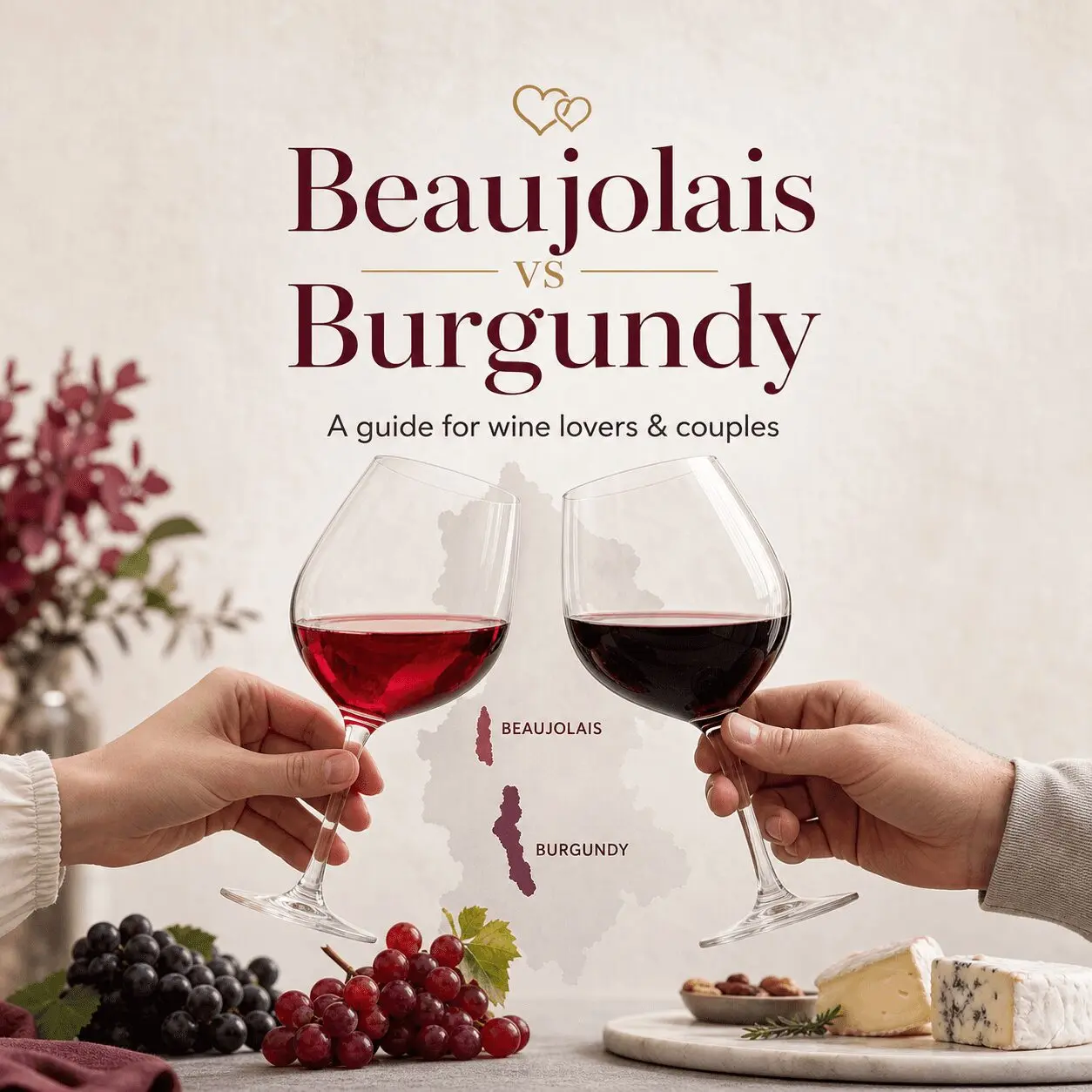
There's something a little funny about Beaujolais and Burgundy. On a map, they're neighbors. In a glass, they can seem light-years apart. And at a dinner party, the conversation quickly turns into a debate. Like, "Burgundy is nobler," or "Beaujolais is more fun." Okay. Let's calm all that down.
The idea here isn't to pick a side. It's more about understanding what you're drinking, why it tastes the way it does, and how to enjoy it, especially if you're coming as a couple, for a weekend, or even… for a wedding in the area. The region offers picturesque landscapes and exceptional wine cellars that can make your stay unforgettable.
Yes, because between the cellars, the landscapes, the little villages, and the estates where you can actually book the whole place for an authentic wedding, this region is honestly made for it.

Why people mix them up, and why that's a (forgivable) mistake
Beaujolais and Burgundy do have things in common.
First, their history. Then, some of their grape varieties. And above all, they're so close geographically that a lot of people lump them together.
Except.
Beaujolais is making a strong comeback. It's mostly gamay, wines that can be crisp, fruity and very approachable, with crus capable of some serious aging. Burgundy is more often pinot noir and chardonnay, with a worldwide reputation, very fragmented appellations, and prices that sometimes make you cough a little.
But it's not "simple vs. complex." It's more like two different ways of telling the story of a terroir.
The basics in 2 minutes: geography, grapes, style
On the Beaujolais side
Beaujolais stretches north of Lyon, with hills, golden stone and hilltop villages. The south produces Beaujolais and Beaujolais Villages, often supple and easy to drink right away. These wines are perfect with dishes like oeufs meurette made with Beaujolais nouveau. The north is home to the 10 crus: Morgon, Moulin à Vent, Fleurie, Brouilly, Côte de Brouilly, Chiroubles, Juliénas, Saint Amour, Régnié, Chénas.
Main grape: gamay noir à jus blanc. And that matters. Gamay loves to deliver fruit, but on granite and good terroirs, it takes on a deeper dimension.
On the Burgundy side
Burgundy is longer and more spread out. People often talk about Chablis, Côte de Nuits, Côte de Beaune, Côte Chalonnaise, Mâconnais. Every village, every climat, almost every single plot has its own identity.
Main grapes: pinot noir (reds), chardonnay (whites). Plus a few exceptions, but let's keep it simple.
Burgundy style, at its best, is all about finesse, nuance and texture. And yes, the price often follows that idea of rarity.
The taste in the glass: what to really expect
Let's be real.
Beaujolais: fruit, flowers, spice, and sometimes serious stuff
Beaujolais, especially crus like Moulin à Vent or Morgon, can gain real structure and depth. These wines are lovely to enjoy at a celebration, because they're often:
- cherry, raspberry, wild strawberry
- violet, peony (yes, you can really smell it)
- pepper, licorice, sometimes a hint of warm stone
- a juicy palate with lively acidity and tannins that are often softer
That said, some crus age very well over 5 to 10 years, or even longer. For those planning a stay in this wine region before or after their wedding celebration, here are a few itinerary ideas for exploring Beaujolais while enjoying its natural beauty and excellent wines.
Burgundy: precision, earth, forest floor, tension
In red (pinot noir), you'll often find:
- cherry, redcurrant, raspberry, but more "refined" than "indulgent"
- forest floor, mushroom, humus with age
- sometimes a smoky touch, a hint of leather
- fine tannins, a lace-like feel, but one that can linger for a very long time
In white (chardonnay), it can range from:
- lemon, green apple, white flowers (taut, crisp style)
- all the way to butter, hazelnut, brioche (riper or more oak-aged style)
And here too, the terroir speaks. Loudly. Sometimes it even speaks too fast for a beginner's palate, which is perfectly normal.
Carbonic maceration, aging, and other words you hear but don't dare ask about
Beaujolais is known for carbonic or semi-carbonic maceration, especially for young wines. It's a technique that brings out fruity aromas, softness, that easy "glug glug" side. But careful: the crus can be made in a more classic way, with extraction and aging.
Burgundy, on the other hand, often relies on more traditional winemaking: destemming or whole-cluster fermentation depending on the estate, aging in barrels that are more or less new, a constant quest for precision.
And in the end, that's what creates the difference in how they feel in your mouth. Beaujolais: more immediate, more energetic. Burgundy: more textured, more velvety, more about the finish. Okay, that's simplifying things a bit, but you get the idea.
If you're thinking about having a wedding in this beautiful French wine region, or even an elopement in French wine country, there are seasonal guides to choosing the best time for a vineyard wedding in France.
And if you'd like to give your guests a memorable experience during your wedding, like wine tours for wedding guests, that could be a great idea. And don't forget to incorporate wine tastings into your wedding weekend: it's a fantastic way to add a personal touch to your celebration!
Price and pleasure: is Burgundy always worth more?
No. And yes. It depends.
Burgundy has huge prestige, worldwide demand, vineyard plots that are sometimes tiny, and a highly prized hierarchy of appellations. The result: even "entry-level" bottles can be expensive.
Beaujolais, meanwhile, remains more affordable, especially if you explore the crus and the winemakers who get less media attention. And honestly, when it comes to pleasure for the price, there are some real gems.
One simple tip: if you want a bottle to treat yourselves without breaking the bank, explore Fleurie, Juliénas, Brouilly, Morgon. If you want an affordable Burgundy, look to the Côte Chalonnaise or the Mâconnais, depending on your taste.
Food and wine pairings: the special couples' guide (dinner, picnic, brunch)
Because yes, this question comes up all the time. And that's often where the Beaujolais vs. Burgundy choice gets very concrete.
For a dinner for two, a little romantic but not stuffy
- Beaujolais cru (Fleurie, Chiroubles): roast poultry, grilled vegetables, slightly spicy vegetarian dishes, charcuterie boards
- Morgon or Moulin à Vent: duck, mushrooms (maybe in a mushroom puff pastry), slow-cooked dishes, veal chop
- Burgundy pinot noir (Côte de Beaune, Côte Chalonnaise): boeuf bourguignon (obviously), mushroom risotto, aged cheese
- White Burgundy (Mâconnais, Côte de Beaune): fish with lemon butter, scallops, poultry in cream sauce
For a picnic in the vineyards
Beaujolais, very often. A lightly chilled red, rillettes, comté, tomatoes, bread. It's simple. It works.
For brunch or a light lunch
Go for a crisp white Burgundy or a very light Beaujolais, depending on the season. If you're more into eggs, salmon and toast, white is your friend.
Weddings and big tables: which wine style pleases everyone
A sensitive topic, because a wedding is rarely 12 people who all love natural wines and ultra-delicate pinots. However, choosing the right season for your wedding or event in Beaujolais can have a positive influence on your choice of wine.
In general:
- Beaujolais: a great choice for the apéritif, the starters, and even the main course if you're going with white meat, poultry or fairly modern cuisine. It's an easy crowd-pleaser, it's served slightly chilled, and it holds up well.
- Burgundy: magnificent with a gourmet meal, especially if you have a very precise menu. But watch the budget. And watch the style too: some very "terroir-driven" Burgundies can surprise palates that mostly drink big, powerful reds.
The combo that often works: Beaujolais cru for the apéritif and part of the meal, then one or two higher-end Burgundy cuvées for the wine lovers, as an option. A little like a wink.
Beaujolais vs. Burgundy: which to choose based on your drinking personality
Yes, it's a bit of a caricature. But it's useful.
You love generous, easy-drinking reds
Beaujolais. Especially the crus. And you can even cellar a few bottles, nobody's stopping you.
You love to analyze, compare, and taste the difference between two plots
Burgundy. Clearly. It's an endless playground. Sometimes frustrating, but endless.
You want a beautiful bottle as a gift
If you know the person's taste, a Burgundy can make quite an impression. But a well-chosen great Beaujolais cru can be the smartest gift of the evening. The one that surprises.
You're a couple on a weekend away, and you want pleasure without the headache
Beaujolais, then a trip into Burgundy if you feel like it. Or the other way around. But start simple.
A trip idea: vineyards, tastings, a pool, and real time together
If you're reading this while planning a trip, or even an event, there's an option a lot of couples love: staying right in the middle of the vineyards, in a place that's also a wine estate.
In Beaujolais, Domaine de Vavril offers exactly that: an estate in the heart of the region, with on-site accommodation for groups, beautiful outdoor spaces, and a real wine and terroir dimension. For those planning a wedding or a big party, it's also a venue you can book exclusively, which changes everything logistically.
The idea isn't just "sleeping somewhere." It's about experiencing wine right where it's made. In the morning, a walk through the vines. In the afternoon, a tasting of the best crus. In the evening, a long table with delicious food paired with local wines. And if it's summer, well, the heated pool tends to win everyone over.
For those planning to organize the perfect anniversary celebration, or even to organize a destination wedding, these experiences at Domaine de Vavril can truly make those moments unforgettable.
How to do a side-by-side tasting and get it right (even as a beginner)
A simple little plan you can do as a couple.
- Get a Beaujolais cru (e.g., Morgon) and a Burgundy pinot noir (e.g., Côte Chalonnaise).
- Serve them at the same temperature, ideally around 14 to 16°C for reds.
- Taste them first without eating. Just note: fruit, acidity, tannins, finish.
- Then have a bite of cheese or charcuterie. Taste again.
- Finish by talking about what you like, not about which one is "better."
It sounds silly, but that's what wine is about too. A conversation.
Classic mistakes (and how to avoid them)
- Thinking Beaujolais = Beaujolais nouveau: no. Nouveau is a tiny part of the story.
- Buying a random Burgundy thinking it's bound to be great: no again. There are disappointments, especially on a small budget.
- Serving reds too warm: that's mistake number one. A gamay that's too warm turns flabby. A pinot that's too warm turns heavy.
- Chasing performance: this isn't a competition. Look for pleasure, and for the right context.
To wrap up, without picking a winner (sorry)
Beaujolais and Burgundy aren't really opposites. They complement each other.
Beaujolais is often about welcome, energy, fruit, sharing, the table that keeps getting longer and where everyone helps themselves to another glass. Burgundy is precision, nuance, the moment when everyone goes quiet for two seconds because the glass is telling you something a little more mysterious.
And if you're a couple or a group looking to celebrate an important moment in an idyllic setting, why not consider a wedding in the Beaujolais vineyards? It could be the perfect opportunity to enjoy the best of both worlds: the warmth and conviviality of Beaujolais and the sophistication of Burgundy. To do that, we recommend you visit Domaine de Vavril, which offers options for weddings at a Beaujolais wine estate, or even luxury weddings in Beaujolais wine country. You can also check out their complete guide to French vineyard wedding costs to better plan your special event.
Frequently Asked Questions
What is the main difference between Beaujolais and Burgundy?
Beaujolais is mostly made from the gamay grape, giving crisp, fruity, approachable wines, while Burgundy mainly uses pinot noir for reds and chardonnay for whites, with wines known for their finesse, nuance and complexity.
Why do people often confuse Beaujolais and Burgundy?
They're close geographically and share part of their history and some grape varieties, which leads many people to lump them together. However, their terroirs, styles and appellations are distinct.
Which Beaujolais crus should you know?
The 10 Beaujolais crus are: Morgon, Moulin à Vent, Fleurie, Brouilly, Côte de Brouilly, Chiroubles, Juliénas, Saint Amour, Régnié and Chénas. These crus produce deeper wines that are capable of aging.
Which areas make up Burgundy wine country?
Burgundy includes several subregions such as Chablis, Côte de Nuits, Côte de Beaune, Côte Chalonnaise and Mâconnais. Each village or climat has its own unique identity when it comes to winemaking.
How can you make the most of a stay in the Beaujolais and Burgundy region?
The region offers picturesque landscapes, exceptional wine cellars and estates where you can book an entire venue for an authentic wedding. It's ideal for a couple's weekend or a special event.
Is the price of Burgundy wines justified?
Yes, the price often reflects the rarity that comes from the fragmentation of the appellations, and the exceptional quality of wines that play on the finesse and complexity of unique terroirs.