
Vineyard Wedding in France: Regions, Venues and Budget
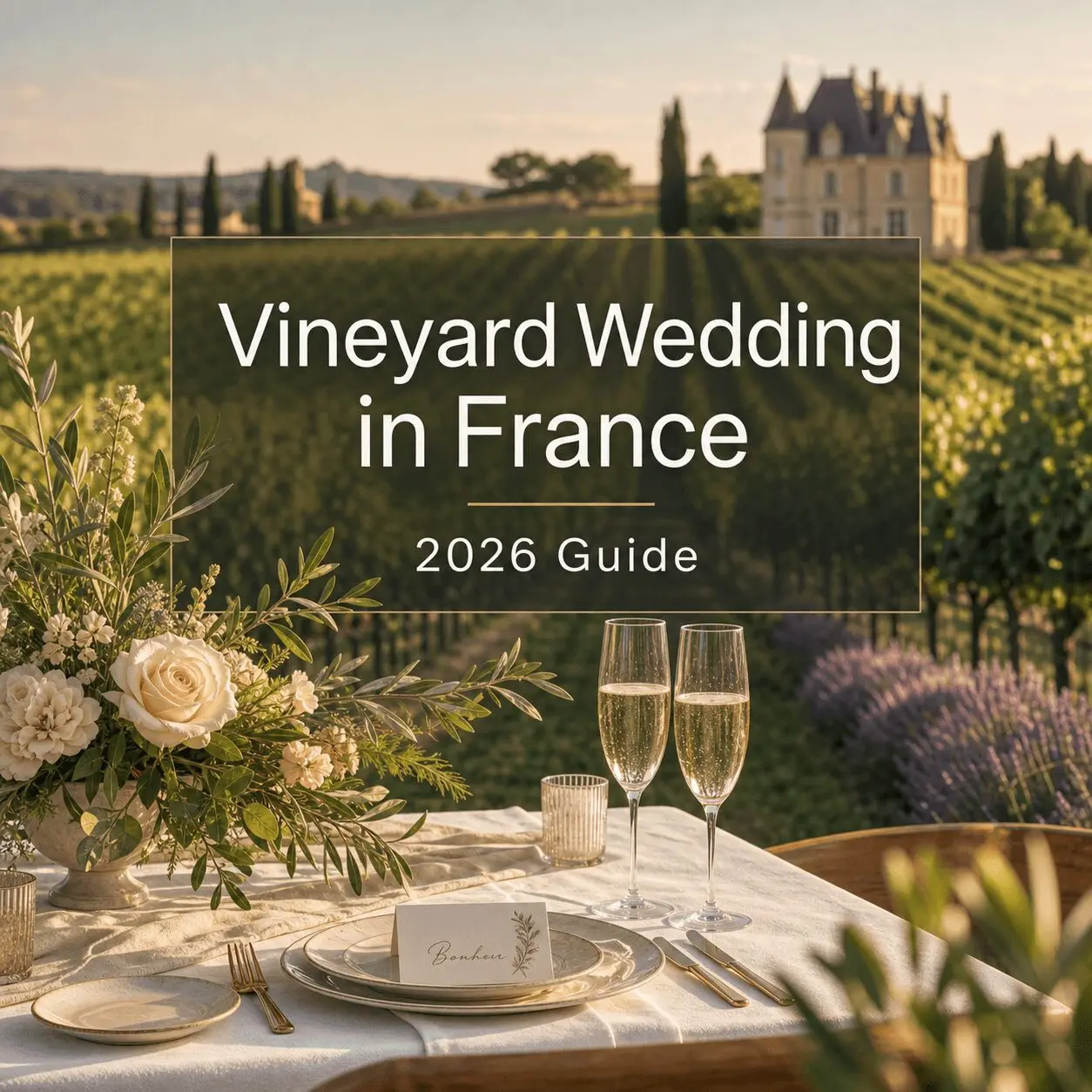
A vineyard wedding in France means celebrating on a wine estate, most often in Beaujolais, Bordeaux, Burgundy, Champagne, the Loire Valley or Provence. This guide compares those regions, the best months, what it costs and how to plan a relaxed three-day weekend.
The vines do much of the work for you: the setting needs little decoration, the wine is already on the table, and most estates are built to receive people. What catches couples out is everything else: the harvest calendar, the rules of a working farm, the heat of a July afternoon and the drive back from dinner at two in the morning. This guide is about getting those right.
In short
- Six regions host most vineyard weddings in France: the Beaujolais, Burgundy, Champagne, Bordeaux, the Loire and Provence. The nearest airport or TGV station matters as much as the view.
- June and September are the sweet spots. The harvest now often starts in August (13 August in the Beaujolais in 2026), so ask each estate about its own picking dates.
- A legal wedding cannot take place in the vines: civil marriages happen at the town hall. A symbolic ceremony among the vines is possible wherever the owner allows it.
- An estate that makes its own wine can supply your reception, which keeps the drinks list simple, local and easy to budget.
- Look for exclusive use and rooms on site: a three-day weekend on one estate is the easiest format for guests coming from abroad.
Updated October 2026.
Why a vineyard, and not just a chateau?
A chateau wedding can be wonderful. A vineyard estate offers something slightly different:
- The setting is already dressed. Vines, terraces, cellars, stone walls and hills that change colour through the season.
- Wine becomes part of the story. Not just something you serve: a tasting on arrival, the estate’s own bottles at dinner, a few to take home.
- The spaces flow naturally. Ceremony outdoors, drinks facing the vines, dinner in a stone hall or courtyard, dancing inside.
- It feels relaxed but still elegant. Guests can wear linen and still feel dressed up.
There is a practical side too: many estates are designed for hospitality, with reception rooms, accommodation, a kitchen for the caterer, parking and staff who have seen every kind of wedding weekend. We compare the two options in more depth in why choose a French vineyard over a chateau, and our complete guide to Beaujolais wine estate weddings focuses on one region.
The French wine regions for a vineyard wedding
| Region | Wine and landscape | Gateway | Usual harvest | Budget level |
|---|---|---|---|---|
| Beaujolais | Gamay on granite hills, 12 appellations including 10 crus | Lyon (about an hour) | Mid-August to mid-September | €€ |
| Burgundy | Pinot noir and chardonnay on the Côte d’Or | Paris (TGV to Dijon), Lyon | Late August to September | €€€ |
| Champagne | Chalk slopes and cellars around Reims and Épernay | Paris (45 minutes by TGV) | Late August to September | €€€ |
| Bordeaux | Grand chateaux in the Médoc and Saint-Émilion | Bordeaux airport, TGV from Paris | September to early October | €€€ |
| Loire Valley | Chenin, sauvignon and cabernet franc along the river | Paris (TGV to Tours), Nantes | September to October | €€ to €€€ |
| Provence | Rosé, olive groves and lavender | Marseille, Nice | Mid-August to September | €€€€ |
The budget level compares typical venue prices between regions (€ for the gentlest, €€€€ for the most expensive). Harvest dates move every year with the weather, and have been getting earlier. For regions without vineyards, from Normandy to the Alps, see our guide to wedding venues in France, region by region.
Beaujolais (north of Lyon)
Rolling hills of gamay, golden-stone villages and family estates that feel private rather than touristy. The region has 12 appellations: Beaujolais, Beaujolais-Villages and ten crus, from Saint-Amour and Juliénas in the north to Brouilly in the south, with Fleurie, Morgon and Moulin-à-Vent in between. Many vines are still trained the traditional way, as low free-standing bush vines (en gobelet), which gives the slopes their distinctive look.
Two things make the Beaujolais easy for a destination wedding: Lyon, an hour away, with its airport, TGV station and food scene, and prices that are generally gentler than in Burgundy or Champagne for a comparable estate. Our selection of wedding venues near Lyon and in the Beaujolais is a good place to start a shortlist, along with our guide for UK couples, our advice for couples planning from America and the journey from Lyon to the vineyard.
Burgundy
Some of the most famous vineyard slopes in the world, around Beaune and Nuits-Saint-Georges, with abbeys, chateaux and excellent food. Estates are often small, which suits intimate weddings; prices are higher on the Côte d’Or and gentler further south.
Champagne
Chalk cellars, grand houses and vineyards less than an hour from Paris. Few Champagne houses host private receptions, but many estates and manors do. The cellars stay cool all year, so guests will want a wrap for a visit.
Bordeaux
Big, classic and prestigious: wine chateaux on a grand scale, with prices to match. The right choice for a formal atmosphere; check the drive times, as the vineyards cover a wide area.
Loire Valley
Not a vineyard-only region, but full of wine estates and chateaux surrounded by vines, with rivers, gardens and fairytale architecture. Good value for a chateau with rooms, especially away from the best-known circuit.
Provence
Vineyards alongside olive groves and lavender, in warm southern light. Beautiful, expensive and in high demand: book early, and plan carefully for July and August. Our guide to planning a south of France vineyard wedding covers it in detail.
And elsewhere
Alsace (wine villages and inns), the Languedoc (large estates with southern light at lower prices) and the Rhône Valley also have wine estates that host weddings. Whatever the region, take our vineyard venue checklist on your visits, and read authentic vs commercial French wedding venues before you sign.
When to marry in the vines: season, harvest and heat
The vineyard year, month by month
- April and May: fresh green shoots, mild days, cool evenings. Frost can still hit the vines on clear nights, and weather is less settled.
- June: vines in full leaf, the longest evenings of the year (in the Beaujolais the sun sets after 9.30 pm) and usually comfortable temperatures. The most requested month.
- July and August: lush vines and long days, but hot afternoons, holiday-season traffic and, in dry years, fire-risk restrictions. Plan shade, water and a late ceremony.
- Harvest (mid-August to early October, depending on region and year): the most atmospheric time on a wine estate, and the busiest for the people who run it.
- October: the leaves turn yellow and red, the light softens and evenings cool down. Rain becomes more likely.
- November to March: bare vines and indoor weddings, but more flexibility and lower prices. At Domaine de Vavril, venue hire alone starts from €8,800 including VAT in this season, accommodation included, and shorter stays are possible.
The harvest has moved earlier
Many couples imagine a September wedding with vines heavy with grapes. In some years that is now too late. In the Beaujolais, the official start of the harvest was 6 September in 2024, 19 August in 2025 and 13 August in 2026, after hot, early seasons. Each grower then picks plot by plot, so the estate’s own dates matter more than the regional one.
What it means for you: during the harvest, the estate has teams in the vines, tractors on the lanes and less time for events, and some plots may be off limits. After it, the vines keep their leaves for several weeks, which is why late September and early October still look beautiful. Ask the estate when it usually picks, and whether it hosts weddings during the harvest at all.
Golden hour and the heat
Build the day around the light. In June, golden hour in the vines comes after 8.30 pm; by mid-September, the sun sets around 8 pm. A ceremony at 4.30 or 5 pm in summer avoids the worst of the heat, and leaves time for portraits before dinner. For more on timing, see our seasonal guide to vineyard weddings, our advice on choosing the right season in the Beaujolais and our outdoor vineyard wedding ideas for every season.
What does a vineyard wedding in France cost?
You are paying for a private event on a working estate: the venue, usually with exclusivity, plus food, drinks, staff, suppliers and getting guests there. The total depends far more on your choices than on the vines.
What drives the budget
- Guest numbers, which set the catering, drinks and staffing bill.
- The number of days: one day of hire or a whole weekend with accommodation.
- The season: June and September Saturdays cost the most; winter and weekdays the least.
- The region: Provence and the grand Bordeaux and Burgundy estates sit at the top; the Beaujolais and the Loire are gentler.
- Drinks: the estate’s wine, Champagne for the toast, an open bar or not.
- Rentals and transport: marquees, lighting and furniture if the estate does not provide them, shuttles if guests cannot drive.
A real example
At Domaine de Vavril, in the Beaujolais, a turnkey wedding starts from €17,700 including VAT, accommodation extra. That covers the venue for four days, drinks reception and dinner for 70 guests, a DJ and a photographer. Venue hire alone starts from €8,800 including VAT from November to March, accommodation included. The final price depends on the season, guest numbers, format, menu and the services you add; the online estimate gives you a detailed range in a few minutes.
Two checks before you compare quotes
- Per day or per weekend? A low daily rate can end up higher than a weekend price once you add set-up and the day after.
- HT or TTC? French professional quotes are sometimes shown before VAT (HT) rather than including it (TTC). At 20%, the difference is significant.
For full budgets at different levels, see the cost of a wedding in France, from €15K to €50K and our complete budget guide for French vineyard weddings.
Tastings and the estate’s own wine at your reception
On a wine estate, the obvious choice is to serve its own wine. It tells a story, the bottles do not need transporting, and guests drink what grows outside the window.
- Ask what the estate produces and taste it before you decide: which reds, whites or rosés, and in what quantities.
- Check how it is charged. Wine may be included in a package, sold by the bottle or offered as an option. At Domaine de Vavril, which makes its own wine, wines and spirits are not included in the menu price; the “Domaine’s wines” option in the estimate is calculated on one bottle for four guests.
- Ask about corkage (droit de bouchon) if you want to bring other wines or Champagne: some caterers and venues charge per bottle opened.
- Match the wine to the menu. A Beaujolais cru served slightly cool works with Lyonnais cooking, poultry and cheese; our French wine and wedding pairing guide goes further.
- Plan a tasting for guests on the arrival day, at the estate if it offers one or at a neighbouring grower. At Domaine de Vavril, couples who choose the estate’s wines for their wedding can also arrange a tasting with the winemaker. In the Beaujolais, ten crus within a short drive make an easy outing; here are more ideas for a winery reception.
Bottles to take home make good favours. Guests travelling to Great Britain can bring back up to 18 litres of wine (still or sparkling) per adult without paying UK tax or duty, about 24 standard bottles; above that, duty is due on the whole amount (gov.uk). Guests from elsewhere should check their own country’s allowance.
What you can, and cannot, do in the vines
The legal ceremony happens at the town hall
A civil marriage in France must be celebrated at the mairie, in a room open to the public, never at a private venue. At least one of you, or one of your parents, must have a lasting link with the commune, for example at least one month of continuous residence there when the banns are published; two foreigners who do not live in France, and have no parent living there, cannot marry at a French town hall (service-public.fr). A religious wedding in France must follow a civil one: the officiant will ask to see your marriage certificate.
That is why most international couples marry legally at home, then hold a symbolic ceremony at the estate. Our guides explain the legal route for UK citizens and US citizens, and what a certificat de coutume is.
A symbolic ceremony in the vines
A symbolic (or secular, “laïque”) ceremony has no legal value, so it can take place wherever the owner agrees: at the end of a row, in the garden facing the vines, on a terrace above the slopes. A celebrant, a friend or a family member can lead it, and you write it as you wish: vows, readings, rings, music. Here are ideas on how to personalise a ceremony in the French countryside.
A few practical points: vine rows are narrow and the ground is uneven, often sloping, so a grassy headland or garden usually works better than the rows themselves for chairs, older guests and heels. Check where the sun will be at the time of the ceremony, and plan shade and water in summer.
A vineyard is a working farm
- Treatments. Vines are sprayed during the growing season, including on organic estates. French rules set a re-entry interval after a treatment: at least 6 hours, and up to 24 or 48 hours for some products. Ask the estate to plan around your dates.
- The harvest. Machines, teams and tractors take priority in the vines. Picking grapes is not a guest activity unless the grower invites it.
- Respect the vines. No climbing on posts or wires, no glass left in the rows, natural petals rather than plastic confetti.
Fire, fireworks, lanterns and noise
In dry summers, prefectures ban fireworks and sky lanterns, sometimes across a whole département: the Rhône did so around 14 July 2026, and through the 2022 drought. Candles near dry grass need care. Music outdoors usually stops earlier than indoors, and the party moves inside: ask for the estate’s rules in writing. If your photographer flies a drone, check that they are registered and insured, as drone flights in France are regulated.
Logistics: getting a vineyard weekend right
Getting guests there
Choose a region with a strong hub: Lyon for the Beaujolais, Paris and the TGV for Champagne, Burgundy and the Loire, Bordeaux for the Médoc and Saint-Émilion, Marseille or Nice for Provence. From London, Lyon is about 1 hour 40 by air, and there are direct flights to most regional airports; from North America, most guests connect in Paris. Our region-by-region guide details the airports and trains for each area, and our guest guide to the Beaujolais covers trains, cars and where to sleep.
Getting around
Rural France has few taxis and fewer late-night ones. If guests cannot drive, plan shuttles from a central hotel or station, a clear pick-up schedule and returns after the party: people stay later than you think. The simplest answer is to have as many guests as possible sleeping on site. At Domaine de Vavril, 41 guests sleep on the estate.
Accommodation and plan B
Even with rooms on site, you may need nearby hotels, gîtes or B&Bs for the rest: block them early for June and September. And look at the indoor option as carefully as the view: a vineyard ceremony is lovely until it rains. At Vavril, the stone reception rooms seat up to 150 guests for dinner (120 with a dance floor).
Booking timeline
- 12 to 18 months before: choose the region, visit (or start with a video call), book the venue, draft the guest list.
- 9 to 12 months before: book the caterer and key suppliers (photo, video, music), plan accommodation and transport, decide on the type of ceremony.
- 6 to 9 months before: send save the dates, plan flowers and decoration, sketch the weekend schedule.
- 3 to 6 months before: final guest numbers, menu and wine tasting, seating plan, weather plan.
Our checklist for overseas weddings and our checklist for a destination wedding in the Beaujolais go into more detail, and our piece on supplier networks when planning from abroad explains how to find local teams.
A three-day vineyard weekend that does not feel exhausting
A vineyard wedding works best as a weekend: your guests have travelled, so let them breathe.
Day 1: arrival and welcome
- Check in and settle into rooms.
- A relaxed welcome drink in the garden or by the pool.
- A simple dinner: family style, pizzas from a local chef or a light catered meal.
Day 2: the wedding
- A slow morning and getting ready on site.
- Ceremony in the late afternoon, when the light softens.
- Drinks outdoors facing the vines, then dinner and dancing.
Day 3: farewell brunch
- Brunch with local pastries, fruit, cheese and coffee.
- A short tasting or a walk in the vines for those who stay.
- Goodbyes (someone always leaves a tie behind).
With a four-day format, such as Thursday to Sunday or Friday to Monday at Vavril, you gain a quiet day for set-up or rest.
Decoration and photos: let the vineyard do the work
Vineyards already have texture, colour and structure, so this is where couples can save money. Long tables and simple linen, warm lighting (string lights, candles, lanterns), seasonal flowers rather than out-of-season imports, and minimal signage. The photos will be better for it. Here are rustic vineyard decoration ideas that work and our advice on planning a more sustainable wedding at an estate.
For photos, build the timeline around golden-hour portraits in the vines, a short walk to a viewpoint, candlelit dinner shots after sunset and the reception lit up at night. When you compare venues, ask for galleries of real weddings rather than styled shoots: you can see real weddings at Vavril in our photo gallery. Our photography guide for vineyard weddings and the shots to request from your photographer will help you brief yours.
What couples choose now
- Weekend weddings with fewer guests: sixty people for three days rather than a hundred and forty for one night. See our guide to micro-weddings in French vineyards.
- Less decoration, better food and atmosphere.
- Local wine and food at the centre, so guests feel they are somewhere, not at a generic wedding.
- Privacy: estates that are yours alone rather than busy tourist venues. For inspiration, see our fairytale vineyard venues and vineyard venues known for luxury.
Questions to ask a vineyard estate
- Is the whole estate ours, or shared with visitors, a tasting room or other events?
- Where exactly can the ceremony take place, and what is the plan if it rains?
- When do you usually harvest, and do you host weddings during it?
- Will the vines near the ceremony be treated in the days before?
- Which of your wines can we serve, at what price, and is there corkage on others?
- Do we choose our caterer, or work with your partners?
- How many guests sleep on site, and what is nearby for the others?
- What is the music curfew outdoors and indoors?
- What are the rules on candles, fireworks and lanterns in summer?
- How do suppliers and shuttles reach the site, and where do cars park?
Common mistakes
- Booking before understanding the rain plan.
- Assuming everyone will “just take a taxi”. In rural France, that is rarely possible late at night.
- Planning a September wedding “for the grapes” without checking the estate’s harvest dates.
- Assuming the legal ceremony can happen in the vines.
- Putting chairs in the vine rows and older guests on a slope.
- Forcing a city timetable onto a countryside weekend: let the day breathe.
- Underestimating the drinks budget. Ask for wine prices before you fix the menu.
FAQ
Can you legally get married in a vineyard in France?
No. A civil marriage in France must be celebrated at the town hall (mairie), and one of you, or a parent, needs a lasting link with the commune, such as a month of continuous residence. Most international couples marry legally at home and hold a symbolic ceremony in the vines, which can take place anywhere the owner allows.
When is the best time for a vineyard wedding in France?
June and September are the most comfortable months, with green vines, mild evenings and long daylight. The harvest now often starts in August, so a September wedding may fall just after the picking; late September and early October bring autumn colours. July and August are possible with shade and a late ceremony.
How much does a vineyard wedding in France cost?
It depends mainly on guest numbers, the number of days, the season and the region. As a real example, a turnkey wedding at Domaine de Vavril in the Beaujolais starts from €17,700 including VAT for 70 guests (venue for four days, drinks reception, dinner, DJ and photographer), accommodation extra. Provence and the grand Bordeaux estates generally cost more.
Which French wine region is best for a vineyard wedding?
The Beaujolais suits couples who want a relaxed estate weekend close to Lyon at a gentler budget; Burgundy and Champagne suit smaller, wine-focused weddings; Bordeaux suits formal, grand settings; the Loire combines chateaux and vines; Provence offers southern light at the highest prices. The best choice is often the one your guests can reach most easily.
Can we serve the estate’s own wine at our wedding?
Usually yes, if the estate produces wine: it is often the simplest and most coherent choice. Ask which wines are available, how they are priced and whether corkage applies to other bottles. At Domaine de Vavril, the Domaine’s wines are an option in the online estimate, calculated on one bottle for four guests.
Can we get married during the harvest?
Sometimes, but the estate’s priority will be the grapes: teams and machines in the vines, less staff time and some plots closed to guests. Ask each estate when it usually picks and whether it hosts weddings during that period. The weeks just after the harvest are often a good compromise.
Where to start
- Pick your region for travel ease and atmosphere.
- Shortlist wine estates that offer exclusive use and rooms on site.
- Ask about availability for your months, and about their harvest dates.
- Build the budget around guest numbers, days and drinks.
If the Beaujolais is on your list, Domaine de Vavril is an 18th-century manor house above Beaujeu, facing the vines, which also makes its own wine. From April to October it hosts one wedding at a time, the whole estate yours for three nights and four days, with gardens overlooking the vineyards, a heated pool and 41 beds on site. Suppliers are selected and negotiated by the Domaine and grouped in one quote, with one contact, Adeline. The online estimate shows a detailed price range in a few minutes and checks your month’s availability in real time, with no commitment. Planning from abroad? Our destination wedding page explains how it works.
Then let the weekend be a little imperfect: slow mornings, long dinners, the wine flowing. That is the point.