
French Marriage Laws Explained for Foreign Couples
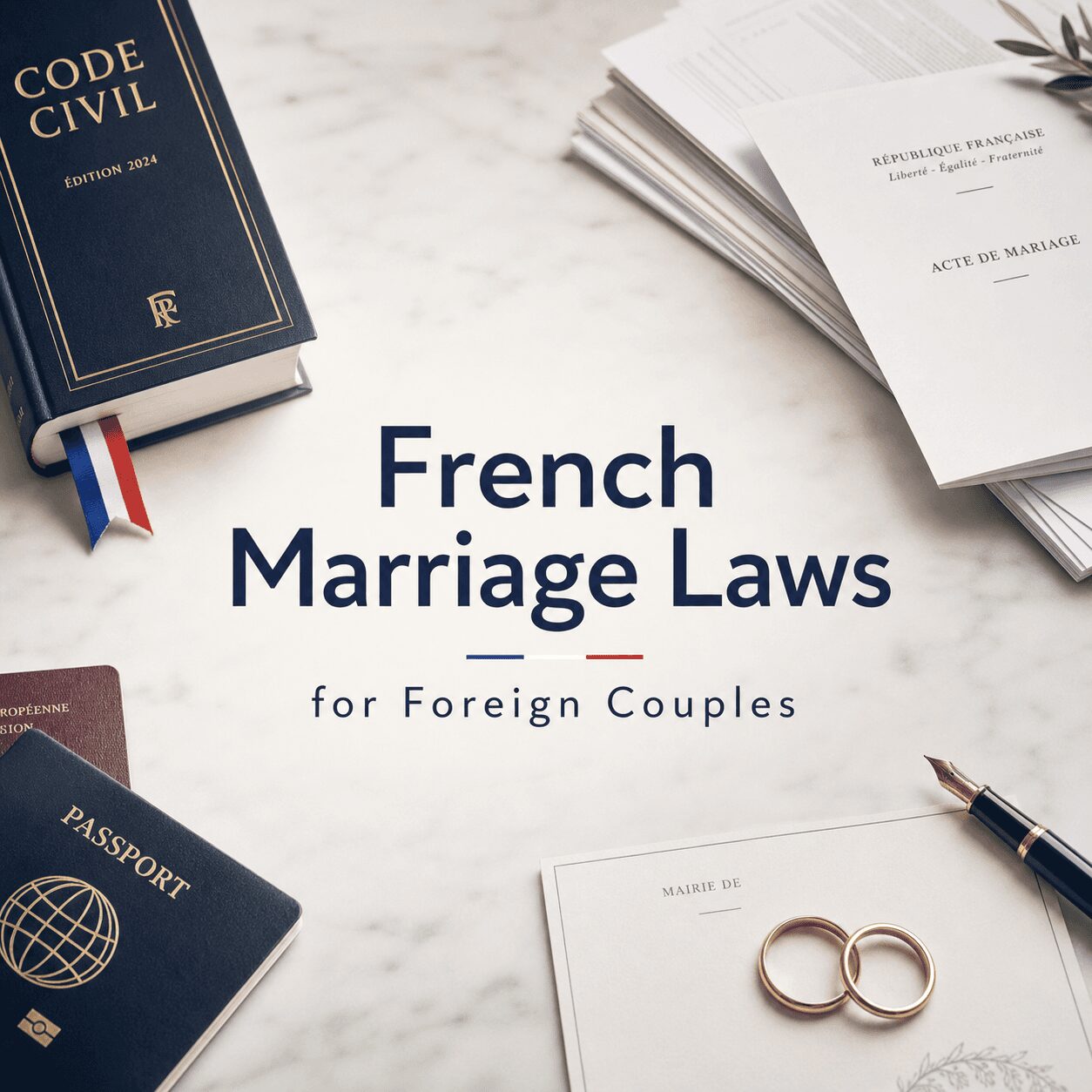
Planning a wedding in France sounds like the dream. Old stone walls, vineyards, a long table outside, and that specific kind of golden light you only get in the late afternoon. Then you start Googling the legal side and it gets… less romantic. Papers. Rules. Appointments at the mairie. Words like publication des bans that suddenly feel very serious.
So let's make this simple.
This guide explains how marriage law works in France for foreign couples, what's actually required, what surprises people, and what most international couples end up doing instead (because yes, many do).
If you are looking at venues in regions like Beaujolais, for example, and you want the France experience without the admin headache, I will also touch on the practical options people choose at places like Domaine de Vavril, an estate venue that hosts weddings and private events in wine country.
The first thing to know: France separates the legal marriage from the wedding day
In France, only a civil ceremony at a town hall (the mairie) creates a legal marriage. Religious ceremonies are optional and can only happen after the civil wedding.
So if you want to be legally married in France, you are talking about a ceremony led by a civil officer (often the mayor or deputy) in a mairie, following a very specific process.
Everything else, the symbolic ceremony at a venue such as Domaine de Vavril, the blessing, or even celebrant-led vows in a garden, that's not legal in the French system.
However, if you're seeking to combine both legalities with an enchanting experience, there are ways to navigate this landscape. For instance, some couples opt for micro-weddings in stunning vineyard locations which offer a unique blend of intimacy and charm.
Imagine exchanging vows surrounded by lush vineyards under that specific golden light unique to late afternoons in France. A spring wedding in such picturesque settings could indeed be dreamy.
Furthermore, if you're curious about how to perfectly pair French wine with your wedding, or if you're exploring luxury experiences at luxury French vineyard wedding venues, this guide has got you covered!
Can foreigners legally get married in France?
Yes. Foreign nationals can legally marry in France, but there are conditions, and this is where most of the friction starts.
To marry in France, you generally need to meet at least one of these links to the commune (the town) where the mairie is:
- One of you lives there, or has established residence there
- Or one of your parents lives there (sometimes accepted, depending on the mairie)
- In certain cases, a temporary residence arrangement may be accepted, but do not assume this. Many mairies refuse it.
This is the big surprise for destination couples: choosing a venue does not automatically give you the right to marry legally in that town. A venue is not the mairie. The legal marriage is tied to residency and the commune's administrative rules.
What most destination couples do instead (and why)
Because of the residency requirement and the paperwork timeline, many foreign couples do this:
- Do the legal civil marriage in their home country (or at a French consulate in some cases, depending on nationality and situation).
- Then host a symbolic ceremony and reception in France.
It's extremely common. It avoids the mairie residency issue, reduces stress, and still gives you the full wedding experience in France.
And honestly, it also gives you more freedom. You can have your ceremony where you want, outdoors, at sunset, in the gardens, by a pool, in a vineyard.
At an estate venue like Domaine de Vavril, for instance, couples often plan a welcome evening, a ceremony in the grounds, then the reception in the domain's spaces, plus next day brunch. It feels like a full wedding weekend, not just one rushed day.
In fact, with careful planning, such as organizing a surprise marriage proposal at a scenic estate venue, couples can create unforgettable memories while enjoying their dream wedding experience in France.
Image: A classic French wedding setting in wine country
(If your WordPress media library has a better on-brand image, swap the link. This is here as a visual placeholder.)
If you do want the legal marriage in France, here is the process
1) You apply at the mairie where you qualify
You cannot just pick Paris (unless you live there). You apply at the mairie of the commune where one of you has residency or a qualifying connection.
The mairie will give you a list of required documents. It varies slightly by town, and some are stricter than others.
2) You submit a marriage file (dossier de mariage)
This is the bundle of documents, forms, translations, and sometimes interviews.
3) Publication of banns (publication des bans)
France requires a public notice of your intention to marry, usually posted at the mairie for a period (commonly 10 days). The marriage cannot legally happen before this.
4) The civil ceremony happens at the mairie
It's in French, formal, and it follows a set structure. You sign the registers, you get your livret de famille, and you are legally married under French law.
What documents do foreign couples usually need?
Exact requirements depend on nationality and mairie, but these are common.
Typical document checklist (very common requests)
- Valid passports or IDs
- Full birth certificates (often long-form, with parents' names)
- Proof of address in the commune (or proof of eligible link)
- Proof of nationality
- If previously married: divorce decree or death certificate of former spouse
- A certificate of custom / certificate of capacity to marry (certificat de coutume / certificat de capacité matrimoniale) for some nationalities
- A certificate of célibat (single status), sometimes requested
- A translator's sworn translations (traduction assermentée) for non-French documents
- Completed mairie forms
- Witness information (usually 2 to 4 witnesses, adults, with ID)
A note that matters: France can be picky about document age. Some mairies want recent copies issued within the last 3 months (sometimes 6 months if issued abroad). Do not order documents too early "just to be safe" because they can expire for the file.
While planning your wedding in France, it's worth considering incorporating some traditional elements into your ceremony. For insights into French wedding traditions, this guide provides valuable information.
If you're contemplating a vineyard wedding instead of a château one, you might find this article on why choose a French vineyard over a château wedding quite enlightening.
Moreover, understanding what makes Domaine de Vavril unique among French estates can add an extra layer of charm to your wedding planning. Get an insider's perspective with this detailed account on [what makes
Image: The mairie step (civil marriage) is the legal one
The translation and apostille problem (the part that eats time)
For foreign documents, France often requires:
- Sworn translations by an approved translator, which can be a lengthy process. You can find more information about this here.
- Depending on the country: an apostille (or legalization) to certify the document for international use.
This is where timelines stretch.
Because you might need:
- A new official birth certificate
- Then an apostille from the issuing authority
- Then a sworn translation in French
- Then appointment availability at the mairie
If your wedding date is fixed, you want to start early. Like, earlier than you think.
Residency: what does it actually mean?
This is the part couples try to negotiate, and it's not always flexible.
A mairie may require proof that one partner has an established residence in the commune. This can mean:
- Utility bill
- Lease agreement
- Tax documents
- Formal attestation of hosting (in some cases), plus ID of the host
If you are renting a holiday home for a week, that is not usually considered residency in the way the mairie means it.
Some couples attempt to "create residency" temporarily. Sometimes it works, sometimes it does not, and it depends heavily on the mairie and the exact proof. You should treat this as uncertain unless the mairie confirms it in writing.
Interviews and anti sham marriage checks (yes, it can happen)
French authorities take sham marriages seriously. In some cases, the mairie can request an interview with the couple, sometimes separately, to verify the relationship is genuine.
This is more common when:
- There is a language barrier
- There is a significant age difference
- There are immigration implications
- Documents raise questions
- One partner's status is complex
If it happens, it does not automatically mean trouble. It just means more time, more admin, and you need to be calm and consistent.
Same sex marriage in France (for foreign couples)
France recognizes same sex marriage. Foreign same sex couples can marry in France, but eligibility can depend on nationality circumstances, and again, the mairie will apply the rules carefully.
If one partner is from a country where same sex marriage is not legally recognized, it can add complexity on the documentation side. Not always a deal-breaker, but it's something to discuss early with the mairie or a French legal professional.
How witnesses work in France
You need at least 2 witnesses and up to 4.
Witnesses:
- Must be adults
- Can be friends or family
- Do not need to be French citizens
- Need valid ID
If your witnesses do not speak French, it's not always a legal issue, but it can affect how smoothly the ceremony goes. Some couples choose witnesses who can follow the French reading, just to avoid awkwardness.
For those considering a unique wedding experience like elopement in French wine country, or dreaming of real weddings at French vineyards, it's essential to understand these factors.
Moreover, if you're weighing between UK manor houses vs French vineyards, knowing about the legalities and requirements can help make your decision easier.
In case you're looking for an all-inclusive package for your elopement in the picturesque French wine country, there are all-inclusive elopement packages available that cater to your needs.
Lastly, if you're a UK couple planning a wedding in France's scenic vineyards, this guide for UK couples could provide valuable insights.
Do you need a prenup in France?
France has default marital property regimes. If you do nothing, you typically fall under a standard regime (often communauté réduite aux acquêts, meaning assets acquired during marriage may be shared).
If you want a different arrangement, you may need a marriage contract (contrat de mariage) prepared with a French notaire before the wedding. This is not just for wealthy people. It can matter if:
- You own property already
- You run a business
- You have children from a previous relationship
- You have assets in multiple countries
Cross-border couples should take advice here, because what you assume applies in your home country may not apply the same way under French rules.
Interestingly, budget-friendly elopement ideas in French wine country could provide an alternative to traditional weddings, allowing couples to navigate these complexities with more ease.
Name changes: does marriage change your name in France?
In France, marriage does not automatically change your legal name the way some countries do. You can use your spouse's name as a usage name in many contexts, but your birth name remains your official legal identity in many French documents.
If you want to change your name on passports or home country documents, that's handled through your own national authorities, not France.
After the ceremony: what proof do you get?
You typically receive:
- A livret de famille (family record book)
- A marriage certificate extract or full copy (you can request copies)
For international use, you may later need:
- Multilingual extracts (in some cases)
- Apostilles or legalization for use back home
- Certified copies
If you are using the marriage for immigration, tax, or legal status, plan ahead and request extra official copies. It's important to understand the apostille requirements to ensure your documents are recognized internationally.
Image: The "wedding" can be a whole weekend, not just the mairie appointment
So what is the simplest path for most foreign couples?
If your priority is:
- a relaxed planning process
- no mairie residency stress
- no document deadline panic
- a ceremony that looks and feels like what you pictured
Then the simplest route is usually:
Legal marriage at home, then a symbolic wedding in France.
This approach not only alleviates the stress of legalities but also aligns perfectly with how many venues operate. A private estate, such as Domaine de Vavril, is built for hosting. With ceremony space, reception rooms, accommodations, and catering partners all on-site, it offers the real "France wedding" experience most couples desire.
If you're currently considering Beaujolais for your wedding and envision a vineyard backdrop with on-site accommodation for guests, Domaine de Vavril could be your ideal choice. It's the sort of place where a symbolic ceremony works beautifully because the space is designed around the celebration, not administrative constraints. You can inquire about their availability and explore options to personalize your wedding ceremony in the French countryside.
Quick FAQ (the stuff people ask again and again)
Can we get legally married at our wedding venue in France?
No. The legal ceremony must happen at the mairie.
Can we do the civil ceremony and reception on the same day?
Sometimes, yes. But mairie scheduling can be limited (weekday mornings, limited slots), and it may not align with your perfect timeline.
If you're interested in planning an intimate French vineyard wedding from America, it's crucial to understand the unique aspects of planning your intimate French vineyard wedding from America. Additionally, if you're weighing the pros and cons between authentic versus commercial French wedding venues, our comparison on authentic vs commercial French wedding venues might provide valuable insights.
For those considering a more eco-friendly approach to their big day, exploring sustainable wedding venues in French vineyards could be beneficial. Lastly, if you're curious about what to expect at a French vineyard wedding, our guide on what to expect at a French vineyard wedding will offer you some useful information.
Do we need a French translator at the civil ceremony?
Not always mandated, but if neither of you speaks French well, the mairie may require an interpreter so you fully understand what you are signing. It's best to ask early.
How far in advance should we start if marrying legally in France?
Practical answer: months. Sometimes longer. Document collection, apostilles, translations, mairie appointment availability, banns timing. It all adds up.
Is a religious ceremony legal in France?
Not by itself. Religious ceremonies can only happen after the civil marriage.
A gentle reality check (because it saves tears later)
People sometimes feel disappointed when they learn they cannot easily do a legal destination marriage in France without the residency link. But once you accept it, planning gets easier.
You can still have:
- vows in a garden
- a celebrant who tells your story
- a reception that goes late
- brunch the next day
- photos that look like a movie
You just separate the legal paperwork from the celebration. Two steps. One love story.
If you are planning a wedding in Beaujolais
If your vision is more "estate weekend in wine country" than "town hall paperwork marathon", it's worth looking at venues that are set up for that kind of flow.
You can explore Domaine de Vavril, which offers not only beautiful reception areas and outdoor spaces but also accommodations and partnerships to make your wedding planning smoother. If you're considering hiring a professional to assist with the planning process, you may want to read about the benefits of hiring a French wedding planner. And if you already have a date in mind, send an availability request early. Wedding calendars fill faster than people expect, especially for the warm months.
For those considering an international perspective on marriage, such as getting married in Korea, there are specific services and requirements that one should be aware of.
Final note (important)
This article is a practical overview, not legal advice. French requirements can vary by commune and by nationality, and rules can shift. Before making commitments, confirm directly with the mairie where you plan to marry, and consider speaking to a notaire or legal professional for cross-border situations.
That said. You are not the first foreign couple to do this, not even close. With the right plan, it can be smooth.
And still feel like France. Which is the whole point.
FAQs (Frequently Asked Questions)
Can foreign couples legally get married in France?
Yes, foreign nationals can legally marry in France, but they must meet certain residency requirements. Typically, one of the couple must live in the commune where the marriage will take place, or have a qualifying family connection there. Temporary residence may sometimes be accepted, but many town halls (mairies) are strict about this.
What is the difference between a legal marriage and a wedding ceremony in France?
In France, only a civil ceremony conducted at a town hall (mairie) creates a legal marriage. Religious or symbolic ceremonies can only happen after the civil wedding and are not legally binding. Many couples choose to have their legal marriage at the mairie and then celebrate with a symbolic ceremony elsewhere.
Why do many international couples opt for symbolic weddings in France instead of legal marriages?
Due to residency requirements and complex paperwork, many foreign couples find it simpler to complete their legal civil marriage in their home country or at a French consulate. They then host a symbolic ceremony and reception in France, which allows for greater flexibility in location and style while still enjoying the romantic French wedding experience.
What is the 'publication des bans' in the French marriage process?
The 'publication des bans' is a public notice of your intention to marry, usually posted at the mairie where you plan to wed. This step is mandatory and serves as an official announcement before the civil ceremony can take place.
Can I choose any venue in France for my legal wedding ceremony?
No. The legal marriage must occur at the mairie of the commune where you meet residency or qualifying conditions. Choosing a beautiful venue like Domaine de Vavril does not grant legal marriage rights there; venues are separate from administrative offices responsible for civil ceremonies.
What practical options exist for couples wanting a French wedding without administrative difficulties?
Many couples opt for micro-weddings or symbolic ceremonies at picturesque vineyard estates such as Domaine de Vavril. These venues offer enchanting settings like outdoor long tables under golden late-afternoon light, allowing couples to enjoy an authentic French wedding atmosphere without navigating complex legal requirements.