
Venue Coordinator vs Wedding Planner in France
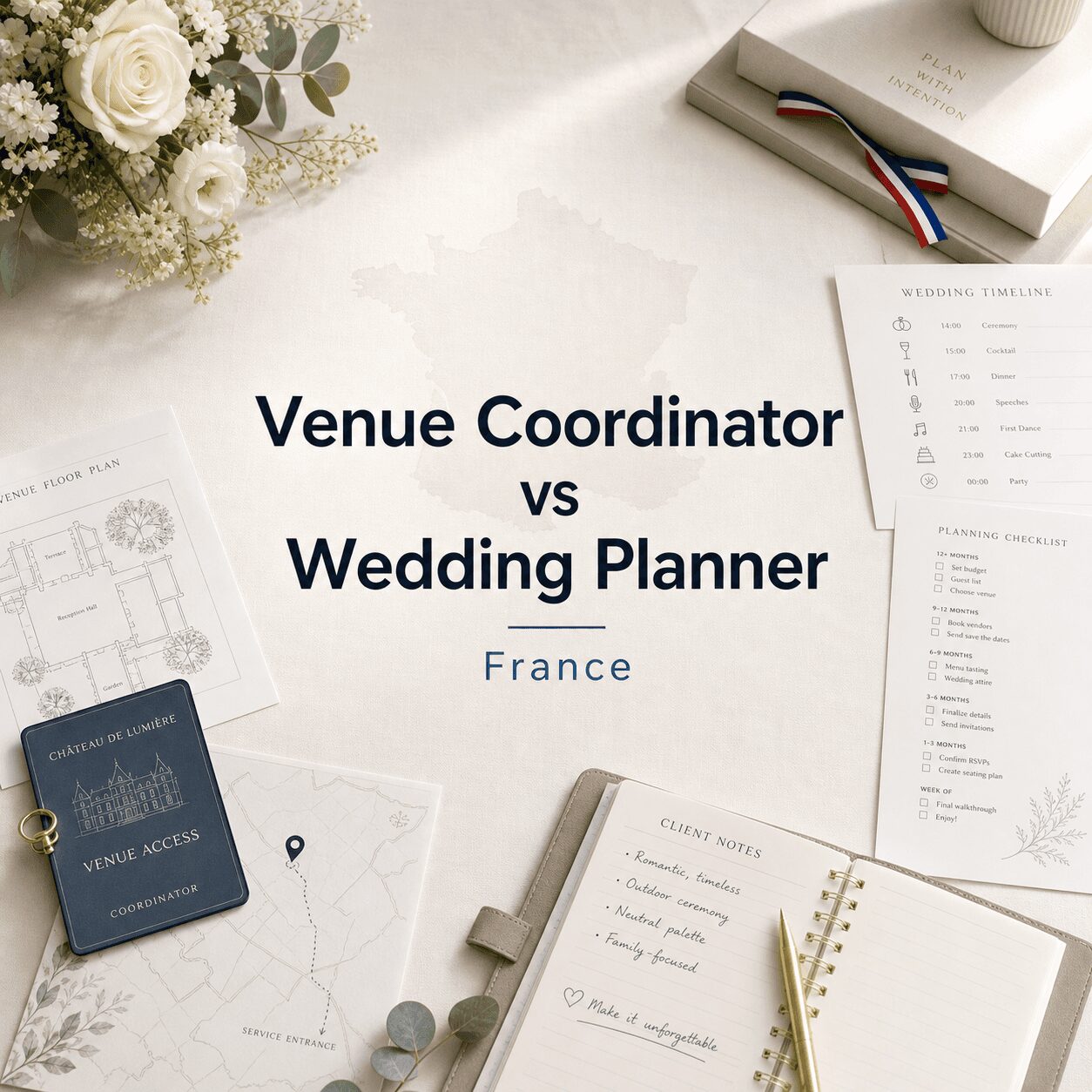
If you are planning a wedding in France, you will hear these two job titles thrown around a lot: Venue coordinator and Wedding planner. They sound kind of similar and people often use them interchangeably. However, understanding their distinct roles can significantly impact your wedding planning experience.
A venue coordinator is hired by, or works for, the venue. Their priority is ensuring that your wedding fits seamlessly into the venue's operations. They manage things like access times, rules, logistics tied to the property, and making sure your vendors adhere to the venue's contract or don't cause any damage to the site.
On the other hand, a wedding planner is hired by you. Their focus is entirely on you – your day, your vendors, your schedule, your guest experience, and all the moving parts involved in making your wedding a success. They can offer full planning services, partial planning or just coordination on the day of the event. But remember, they work for you and not the venue.
This distinction becomes even more crucial when considering specific venues like Domaine de Vavril in Beaujolais, where understanding what the on-site team can do for you and what falls outside their job description is essential.
In addition to these roles, it's also important to recognize the difference between authentic and commercial French wedding venues. This knowledge can help you make an informed decision about where you want to host your special day.
Furthermore, if you're planning from abroad, understanding how to navigate vendor networks while planning for a wedding in France can be extremely beneficial.
Lastly, for those interested in hosting their wedding at a luxury estate while also being mindful of the environment, our guide on how to plan a sustainable wedding at a luxury estate could provide valuable insights.
So whether you're looking for assistance with wedding planning in France, or seeking advice on hiring a suitable wedding planner as detailed in this resource, remember that understanding these roles and aspects will help streamline your wedding planning process.
The real difference is not tasks. It's loyalty and scope.
A venue coordinator is usually fantastic at making the venue side run smoothly, especially in a complex and unique setting like Domaine de Vavril.
A wedding planner, however, is typically the person who ensures that the whole wedding runs seamlessly.
Yes, there is overlap. Both may create timelines, answer vendor questions, and be present on the wedding day. But the scope of their responsibilities is different.
When things get stressful, overlapping tasks does not equate to overlapping responsibility.
What a venue coordinator typically handles (France, real world version)
This varies from venue to venue. However, in France, you will commonly see the venue coordinator covering:
- Site visits and walk-throughs tied to the venue
- Explaining what spaces you can use, when, and how
- Venue logistics: parking, deliveries, noise limits, curfew, backup plan spaces
- Where vendors can load in, where they can store things, power access, etc
- Safety and compliance on site (especially with historic buildings, pools, vineyards, gardens)
- Handing over keys and opening/closing procedures
- Liaising with your planner or caterer regarding venue-related questions
- Being the person who knows the property inside out
At an estate venue like Domaine de Vavril, this kind of role is especially valuable because the property is not just "a room." It encompasses outdoor spaces, reception areas, accommodation, and operates as a working estate. The venue team knows what works best on that specific site which saves you from guesswork.
Additionally, when booking an exclusive use venue in France such as Domaine de Vavril, it's vital to avoid certain pitfalls. For instance understanding top mistakes to avoid when booking an exclusive use venue could save you from unnecessary stress during your planning process.
Moreover if you're considering a vineyard wedding at such a stunning location like Domaine de Vavril or any other similar estate venue in France , having a clear vineyard wedding venue checklist can greatly simplify your decision-making process.
Lastly for those contemplating an overseas wedding; understanding how to choose the perfect wedding venue abroad can provide valuable insights into making this significant decision.
It's also important to note that while planning for your dream wedding at an exclusive use venue like Domaine de Vavril or any other similar estate in France involves various aspects including adherence to building codes which are crucial for safety and compliance on site especially with historic buildings.
What they usually do not do
This is where couples get caught out.
A venue coordinator usually does not:
- Build your vendor team from scratch (photographer, florist, hair and makeup, DJ, celebrant, etc)
- Negotiate contracts across multiple suppliers
- Manage your guest communications
- Plan your ceremony structure
- Design your styling concept and implement it end to end
- Chase RSVPs
- Manage your budget across everything
- Coordinate transport from hotels, airports, cities
- Handle emergencies that are not "venue problems"
- Be your emotional support person at 11 pm when the seating plan implodes
They can still be kind and helpful, of course. But it's not what they are hired to do. And it matters because their time is structured around running a venue.
What a wedding planner typically handles in France
A wedding planner can be hands on from the first email to the final dance, or they can jump in halfway. But in general, a planner may handle:
- Finding and vetting vendors that match your style and budget
- Creating and managing a master budget
- Contract review and negotiation support
- Full timeline planning (not just venue timings, but hair and makeup, photos, transport, ceremony, dinner, speeches, party)
- Guest experience planning (welcome dinner, brunch, wine tasting, activities)
- Design and styling direction, sometimes full production
- Managing logistics across multiple locations and days
- Coordinating vendors on the day and being the main point of contact
- Troubleshooting everything quietly so you don't have to
In France, planners are especially helpful when you have language barriers, when vendors are scattered across regions, or when you are planning from abroad. Which is common.
If you're considering a romantic vineyard wedding in the south of France, it's worth exploring some planning tips specific to that region. Additionally, understanding the costs associated with a French vineyard wedding can help you manage your finances better. For more insight into how to break down your wedding budget effectively, these resources can be invaluable.
"But my venue says they have coordination included." What does that actually mean?
Usually it means.
They coordinate the venue.
Not the wedding.
So you might get:
- A contact person who answers emails
- A run sheet for access times
- Guidance on where things go on site
- Recommendations for caterers and partners who know the venue
At venues like Domaine de Vavril, you will often see a curated list of recommended partners because it makes everything smoother. Caterers who already know the kitchen setup. DJs who know the sound limits. Rental companies who know the access route. That is gold.
But it still doesn't replace someone who is managing your whole supplier team and your full day timeline.
Scenarios where a venue coordinator is enough
Sometimes, you genuinely do not need a wedding planner.
Here are the situations where a venue coordinator plus a solid caterer and a bit of organisation on your end can be totally fine.
1. Small wedding, simple format
Think 20 to 50 guests, one location, ceremony and dinner in the same place, minimal decor, no complicated transport.
2. You are local, bilingual, and have time
If you live in France (or speak French comfortably) and you enjoy admin, you can handle a lot yourself.
3. Your caterer is doing serious coordination
In France, some catering teams basically act like mini planners on the day. Not all. But some do timelines, staffing, furniture flow, service rhythm, and they keep things on track.
4. You do not have multiple days of events
If it's one day only, fewer moving parts. However, welcome dinners and brunches are where coordination suddenly multiplies, especially in a rural destination setting in France where group transportation can be challenging.
Scenarios where you probably want a wedding planner
This is the part people ignore because it feels like an extra cost. Then they regret it later. Not always, but often.
1. Destination wedding (planning from abroad)
If you are planning from the UK, US, Canada, Australia, or anywhere else, a planner becomes your on-the-ground person. This is particularly crucial in France where many vendors are brilliant but not all are "email first, fast reply" people due to cultural differences. A destination wedding planner bridges that gap.
2. You have 80+ guests
More guests means more transport (which a planner can help coordinate), more accommodation questions, more seating plan drama, more everything.
3. Multiple locations
Ceremony in one place, reception in another (potentially a beautiful winery wedding reception), guests staying across different towns. Now you need a traffic controller, basically.
4. You care a lot about design and detail
If you have a clear vision for your wedding ceremony and want it executed properly—perhaps even personalized to fit the French countryside—a planner (or planner designer) will protect that vision. Otherwise you end up DIYing at the last minute, with your cousin holding a glue gun at 3 pm.
5. Your schedule is tight
If you have demanding jobs, kids, or you just don't want wedding planning to swallow your life. Get help. Honestly.
The awkward truth. The venue coordinator cannot be in two places at once.
This is one of the biggest misunderstandings.
Let's say it's your wedding day at a beautiful estate. The coordinator is handling vendor arrivals at the gate, checking that the reception room is set correctly, and making sure the property rules are followed.
At the same time.
- Your florist is asking where to plug in
- Your photographer wants to shift the ceremony time by 20 minutes because of sun
- Your hair and makeup is running late
- Your officiant is missing a mic
- Your uncle is lost on the road in
- Someone needs to move chairs
- Someone else is asking about the vegan meal count
That is not one person's job when they also have to run the venue side of things.
A wedding planner is the person who absorbs that chaos so you don't.
Who manages what, on the wedding day? A simple way to think about it
Here's a practical split that usually makes sense.
Venue coordinator manages:
- Access to the property and key timings (open, close, deliveries)
- Venue spaces and rules
- On site issues linked to the venue (power, heating, water, safety, layout constraints)
- Protecting the venue's operations and staff
Wedding planner manages:
- The full timeline and all suppliers
- Vendor questions that are not venue specific
- Ceremony flow, cues, music timing
- Styling execution, placement of small details
- Guest flow and problem solving
- Keeping you calm and on time
Some couples do a hybrid. They hire a planner just for "day of coordination" or "month of coordination." This is common in France too. It can be the sweet spot.
Questions to ask your venue (before you assume anything)
When visiting venues in France, it's crucial to ask the right questions directly. This can save a lot of confusion later on. Here are some essential questions to consider:
- Will a coordinator be present on the wedding day? For how many hours?
- Do they manage the wedding timeline or only venue access times?
- Are they the main contact for vendors on the day?
- Do they help with ceremony setup and flip from ceremony to dinner?
- What is included in the venue fee, and what is optional?
- Do you provide a list of recommended vendors, like caterers, DJs, planners?
- If it rains, who coordinates the backup plan setup and timing?
For instance, at Domaine de Vavril, it's beneficial to inquire about how the spaces can adapt depending on weather conditions, and how accommodation and on-site flow works for guests. Estate venues usually offer a plethora of options, which is advantageous, but it's important to know who will be managing everything on the day.
The money question: Is a wedding planner worth it in France?
The answer largely depends on what you value.
If you value:
- Time
- Peace of mind
- A smoother guest experience
- Less risk of last-minute chaos
- Having someone fight your corner if something goes wrong
Then yes, it's usually worth it.
On the other hand, if you value:
- Doing it yourself
- Keeping things simple
- Saving budget for food, wine, photography, the actual experience
Then perhaps you might skip hiring a planner and rely on the venue coordinator, caterer, and a well-organised spreadsheet.
There's no shame in either choice. Just remember not to assume that a venue coordinator will seamlessly transition into your full wedding manager role.
When considering venues in France, especially those like Domaine de Vavril, which offer unique experiences such as sustainable weddings in French vineyards, it's essential to have clarity on these questions to ensure your special day goes off without a hitch.
For more comprehensive inquiries that can help you make an informed decision when choosing a wedding venue, consider checking out this resource with 12 questions to ask a wedding venue
A very normal setup that works well at French estates
This is what I see work, again and again.
- You book a venue you love, one that feels like you, with a team that is responsive.
- You use their recommended partners for the big logistical vendors (often catering, rentals).
- You hire the right level of coordination for your wedding.
Coordination options
- A full wedding planner works best for destination weddings, complex logistics, or multi-day events.
- A month-of coordinator suits couples who have planned most things themselves.
- No planner at all can work, as long as you appoint a trusted friend to handle basic day-of communications.
And you communicate clearly who is responsible for what.
That last line matters more than people think.
If you're looking at Domaine de Vavril specifically
If you want a venue in Beaujolais that feels private, green, and very French, Domaine de Vavril is one of those places where the property itself does a lot of the heavy lifting. Gardens, reception spaces, on-site accommodation, and the vineyard setting. It's all there.
So your decision becomes simpler:
- If your wedding is straightforward, one location, and not too many moving parts, you might only need the venue coordination and a strong caterer team.
- If you're planning from abroad and want multiple events or someone to run the whole day like a film set, bringing in a planner might be necessary. For those considering this option, we have compiled the ultimate checklist for organizing a destination wedding in Beaujolais.
If you're at the early stage and want to get a feel for the spaces available at Domaine de Vavril or check availability for your desired date, you can do so directly through their official website.
Additional Resources
For couples considering vineyard weddings in France, it's essential to understand the seasonal guide for the best times to host such events. Also worth exploring are the differences between authentic and commercial wedding venues, which can significantly influence your choice of location. Lastly, if you're planning an intimate French vineyard wedding from America, our resource on planning such weddings from abroad could be invaluable.
Final takeaway (so you can decide fast)
A venue coordinator protects the venue, manages venue logistics, and helps your event fit the property smoothly.
A wedding planner protects you, manages the whole wedding, and connects every vendor and moment into one coherent day.
If your wedding is simple, local, and you like organising. The venue coordinator can be enough.
However, if you're considering incorporating some unique elements like French wedding traditions, or if your wedding is destination, detailed, multi-day, or you just want to enjoy being engaged without running a project plan. In such cases, getting a wedding planner is advisable, even if it's only for the final month and the wedding day.
That's the real difference. Not the title. The responsibility.
FAQs (Frequently Asked Questions)
What is the difference between a venue coordinator and a wedding planner in France?
A venue coordinator is hired by or works for the venue, focusing on ensuring your wedding fits seamlessly into the venue's operations, managing access times, rules, logistics tied to the property, and vendor compliance with the venue's contract. In contrast, a wedding planner is hired by you and focuses entirely on your needs—your day, vendors, schedule, guest experience, and overall wedding success. They offer various planning services but work solely for you, not the venue.
What responsibilities does a venue coordinator typically handle at French wedding venues like Domaine de Vavril?
Venue coordinators manage site visits and walk-throughs related to the venue; explain usable spaces and timings; oversee logistics such as parking, deliveries, noise limits, curfews, backup spaces; coordinate vendor load-in areas, storage, and power access; ensure safety and compliance especially in historic buildings or estates; handle opening/closing procedures; liaise with planners or caterers on venue-related questions; and possess detailed knowledge of the property.
Why is understanding the role of a venue coordinator important when planning a wedding at an exclusive use estate like Domaine de Vavril?
Because estates like Domaine de Vavril are complex properties encompassing outdoor spaces, reception areas, accommodations, and operate as working estates. The venue coordinator's expertise ensures smooth operations tailored to the unique site characteristics, saving you from guesswork and helping avoid common pitfalls associated with exclusive use venues.
How can I avoid common mistakes when booking an exclusive use wedding venue in France?
Familiarize yourself with top mistakes to avoid such as misunderstanding venue policies, overlooking logistical details like noise limits or curfews, neglecting vendor restrictions tied to the property, or not clarifying what services are included. Resources specific to venues like Domaine de Vavril provide guidance that can help reduce stress during your planning process.
What should I consider when choosing between authentic and commercial French wedding venues?
Understanding the differences helps make an informed decision about your special day. Authentic venues often offer unique historical charm and personalized experiences but may have stricter regulations or logistical challenges. Commercial venues might provide more standardized services and amenities. Evaluating your priorities regarding atmosphere, flexibility, and vendor options is crucial.
How can I effectively plan a sustainable luxury wedding at an estate in France?
Planning a sustainable luxury wedding involves selecting eco-friendly vendors, minimizing waste through thoughtful décor choices, utilizing local resources like seasonal food and flowers from nearby producers or vineyards (such as those at Domaine de Vavril), and incorporating energy-efficient practices during your event. Consulting guides focused on sustainable weddings at luxury estates can provide valuable insights tailored to French venues.