
How to Choose a Wedding Officiant in France
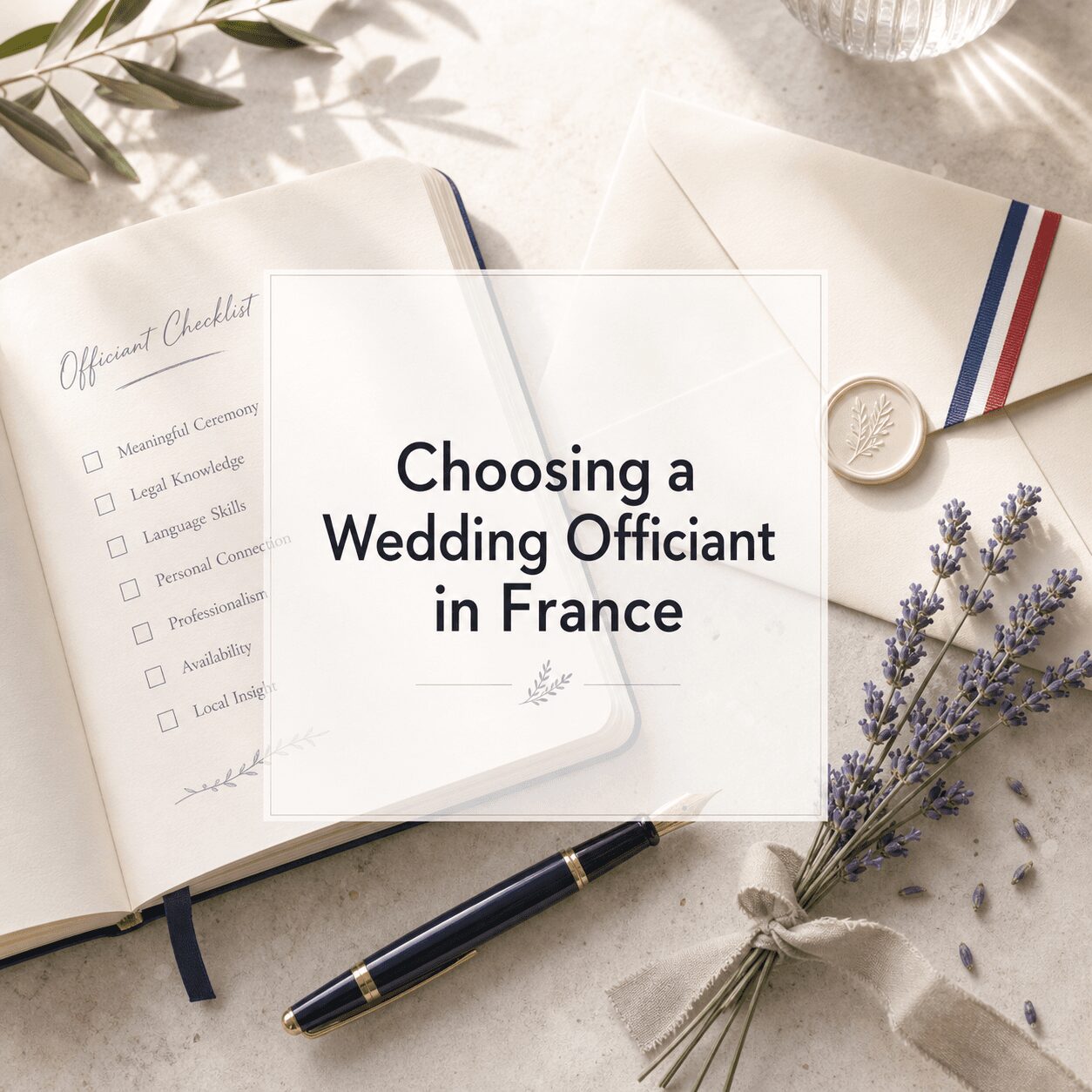
Planning a wedding in France sounds like the dream. The light, the food, the stone villages, the wine, the photos that somehow look like a film still even when nobody tried.
Then you hit one slightly confusing reality.
In France, the "officiant" question is not the same as it is in the US, the UK, Australia, or basically anywhere that lets you legally marry outdoors with your best friend reading vows.
So before you start booking someone with a microphone and a nice blazer, it helps to get really clear on what kind of ceremony you're having, and what "officiant" even means in your situation.
This guide is here for that. The practical stuff, plus the human stuff. And a few gentle warnings that will save you a lot of back and forth later.
First, the big thing most couples miss: legal vs symbolic in France
In France, only a civil ceremony at the town hall (la mairie) is legally binding.
That ceremony is performed by the Mayor or a deputy of the commune, not by a private celebrant.
So if you are imagining a legal wedding ceremony at a vineyard estate or in a garden, that part usually isn't possible. What most destination couples do is one of these:
- Do the legal marriage at home, then have a symbolic ceremony in France.
- Do the legal marriage at a French mairie (only if you meet residency requirements, which can be strict), then celebrate at your venue after.
That's why when people say "we need an officiant in France", what they very often mean is:
We need someone to lead a meaningful, personal, symbolic ceremony in a beautiful place, in the language we want, with the tone we want.
Choosing the right person to officiate this personal ceremony matters significantly. For those considering planning such an event from abroad, there are resources available to help navigate through this process effectively.
Decide what kind of officiant you actually need
Sounds obvious, but it's the step people skip because Pinterest makes it feel like there's only one version of a ceremony.
Here are the common options in France for a wedding celebration:
1) A professional celebrant (most common for destination weddings)
This is a person whose job is to craft and deliver symbolic ceremonies. They write, they structure, they guide the music cues, they manage the flow, they keep it from dragging, and they keep everyone calm when a bee attacks the flowers.
Best for: couples who want a polished ceremony with a strong narrative and zero awkward pauses.
2) A friend or family member as officiant
In France, for a symbolic ceremony, your friend can absolutely "officiate". No legal authority needed.
Best for: intimate weddings, or couples who love the idea of someone close speaking.
But. It's a lot to ask of someone. Writing, public speaking, pacing, managing emotions, holding a mic, telling people to sit down, remembering the rings. And doing it while they're also trying not to cry.
3) A religious officiant
If you're having a religious ceremony (Catholic, Protestant, Jewish, etc.), that's separate and depends on the religion and the location. Some couples do a blessing in France after legal marriage elsewhere.
Best for: couples for whom faith is central to the day.
4) A bilingual MC who "acts" as officiant
Sometimes couples hire an MC or DJ type who also leads the ceremony. This can work, but it depends on their ceremony writing skills.
Best for: very simple ceremonies with minimal personalization.
It's important to remember that each type of officiant comes with its own set of costs. For detailed insights into managing your wedding budget effectively—like understanding where to spend more and where you can save—I recommend checking out this wedding budget breakdown.
If you're getting married at a venue like Domaine de Vavril, what's typical?
At estates and private venues, including vineyard properties, the usual rhythm is:
- Arrival and welcome drinks
- Symbolic ceremony in the garden or a dedicated outdoor space
- Cocktail hour
- Dinner and party
A place like Domaine de Vavril (Vavril) in the Beaujolais is naturally set up for that kind of flow, because it's an exclusive estate with outdoor areas, reception rooms, and on-site accommodations for guests who want to stay close to the celebration. You can explore more about planning your intimate French vineyard wedding from America or consider how to plan a sustainable wedding at a luxury estate.
If you're at the stage of looking at venues, you can start here and check spaces, galleries, and availability: https://vavril.fr
The 9 things that actually matter when choosing an officiant in France
1) Language, but also vibe in that language
A lot of couples say, "We need English." Or "We need French and English."
What you really need is: someone who can be warm, natural, and confident in that language.
Because you can be technically fluent and still sound stiff in a ceremony.
So ask:
- Do you deliver ceremonies in English regularly, or is it occasional?
- Can you show a full video of a ceremony in the language we want?
- Can you handle bilingual transitions without it feeling like a school presentation?
If your guests are mixed, a good bilingual officiant will not translate every sentence. They'll structure it intelligently so everyone feels included without doubling the ceremony length.
When considering wedding venues, it's essential to understand the difference between authentic vs commercial French wedding venues. This knowledge will help you make an informed decision when selecting your dream venue.
Also, keep in mind that budgeting for a wedding can be challenging. To alleviate some of this stress, refer to our comprehensive guide on French vineyard wedding costs, which provides insights into potential expenses.
Lastly, if you're dreaming of a fairytale wedding in the picturesque French vineyards, we have curated some stunning venues that might just be what you're looking for.
2) Experience with destination weddings in France
France has its own wedding rhythm. Venues often have timing constraints, noise rules, neighbors, church bells, weather quirks, and the very French way of handling logistics. An officiant who works destination weddings in France will understand:
- sound setup outdoors
- wind and mic issues
- cueing musicians
- working with planners and venues
- keeping the ceremony within a comfortable time window
It's not glamorous, but it's the difference between "wow that was beautiful" and "why is everyone squinting and fanning themselves and checking the time."
3) Their writing style
Ask for samples. Real samples.
And notice what you feel when you read or watch.
Some officiants lean:
- poetic and lyrical
- humorous and light
- elegant and classic
- simple and modern
None is "right", but mismatching this is where couples get disappointed.
If your relationship is private and not super performative, you probably won't love an officiant who writes like a movie trailer.
And if you love big romance and drama, you might feel underwhelmed by someone ultra minimal.
4) The structure they use (this is quietly huge)
A ceremony is not just words. It's choreography.
A strong officiant will help you shape:
- processional order
- who stands where
- readings and by whom
- vow format
- ring exchange wording
- symbolic rituals (if any)
- music cues
- signing a symbolic certificate (optional but fun)
- recessional
Ask them: "Can you walk us through a typical ceremony structure you recommend, and why?"
If they can't answer clearly, you might be buying vibes instead of skill.
Understanding French Wedding Traditions
It's also important to have an understanding of [French wedding traditions](https://vavril.fr/en/french-wedding-traditions-explained/), as these can significantly influence the flow and feel of your ceremony. From unique customs to specific rituals, knowing these traditions can help you blend your personal style with the local culture for a more authentic experience.
Choosing Sustainable Wedding Venues
For couples who are environmentally conscious, exploring [sustainable wedding venues in French vineyards](https://vavril.fr/en/sustainable-wedding-venues-in-french-vineyards/) could be a great option. These venues not only provide stunning backdrops for your special day but also align with your values towards sustainability.
5) How they handle emotion in the moment
This sounds soft. It's not.
People cry. Someone forgets the rings. A guest faints. Wind knocks the script. A child screams.
Your officiant should be calm and adaptable, not thrown off. They should also possess skills to manage emotional situations effectively, perhaps even knowing how to avoid tears when speaking in public.
This is why video matters. Watch them. See if they can hold a room.
6) Whether they'll collaborate, or control
Some officiants are very "this is my method". Others are collaborative.
You want someone who can lead while still making it your ceremony.
Good signs:
- they ask questions about your story beyond the basics
- they offer options, not ultimatums
- they're happy to include cultural elements
- they don't push cheesy rituals you don't want
7) Their relationship with your other vendors
If you have a planner, loop them in early.
If you don't, make sure the officiant can coordinate with:
- the venue team
- musicians
- sound tech or DJ
- photographer (so key moments aren't blocked)
At venues like Vavril, where the setting is a major part of the ceremony, coordination matters. You want the officiant to respect the space, the timing, and the guest experience.
8) Their microphone and sound plan
Outdoor ceremonies in France can be windy. Or very quiet. Or both.
Ask:
- Do you bring your own mic and speaker?
- Is it battery powered (important outdoors)?
- Do you have a backup?
- Do you do a sound check?
If the answer is "don't worry about it", worry about it.
9) Price, and what's included
Officiant pricing in France (for symbolic ceremonies, especially in English) varies widely.
What changes the price:
- writing time and number of revisions
- bilingual delivery
- travel and accommodation
- coordination and rehearsal
- custom rituals
- experience level
Ask for a clear list of what's included:
- initial consult
- questionnaire or interviews
- script draft timeline
- revision rounds
- rehearsal or walkthrough
- day-of arrival time
- sound equipment (if included)
- travel fees
If the quote is vague, the experience might be too.
Professional celebrant vs friend officiant, the honest pros and cons
Having a friend officiate
Pros:
- deeply personal
- often funnier and more "you"
- cheaper
Cons:
- they may panic
- they might ramble
- they may not know how to pace
- they're working, not enjoying the ceremony as a guest
- sound and cueing issues become your problem
If you do this, consider hiring a pro to write or co-write the ceremony script, even if your friend delivers it. That hybrid approach is underrated.
Hiring a professional celebrant
Pros:
- calm, structured, polished
- better delivery
- better timing
- less stress for you
- they manage the room
Cons:
- cost
- you need to find the right personality match
However, the investment can be worthwhile. For instance, hiring a French wedding planner can significantly enhance your wedding experience by taking care of all these details. Additionally, seeking advice from experienced professionals about officiant services can provide valuable insights. For more information on this topic, check out this blog post by Lois Heckman.
Questions to ask before you book (copy and paste these)
- Do you perform symbolic ceremonies in France regularly? In which regions?
- Can we watch a full ceremony video (not just a highlight reel)?
- How do you build the script? Interview, questionnaire, both?
- How many revisions are included?
- Can you do bilingual French and English without making it too long?
- Do you provide sound equipment? If not, what do you recommend?
- Do you offer a rehearsal or venue walkthrough?
- What's your plan if you're sick or delayed? Do you have a backup officiant?
- What's the total price including travel, and what are the payment terms?
- What do you need from our venue, and by when?
That last one matters more than people think.
A quick note on ceremony length (because guests feel it)
Most great symbolic ceremonies land around 20 to 35 minutes.
Longer can work, but only if:
- the writing is exceptional
- the setting is comfortable
- the sound is perfect
- the schedule allows it
France in summer can be hot. If your ceremony is outdoors at 3 pm, 55 minutes is… ambitious.
If you're choosing a venue with gardens and open-air spaces like Domaine de Vavril, you'll probably want to time the ceremony for softer light anyway, late afternoon tends to be the sweet spot.
Making sure the ceremony fits the place (not just your Pinterest board)
A ceremony should feel like it belongs in the space.
If you're getting married at a vineyard estate in Beaujolais, you can lean into:
- the landscape and terroir
- a subtle wine ritual (not gimmicky, just meaningful)
- local music choices
- a welcome message that nods to travel and gathering
A good officiant will weave the setting in lightly, without turning it into a tourism speech.
And if you're still choosing the venue, it's worth looking at estates that can host the whole weekend vibe, not just the dinner. Vavril is a prime example of that kind of place, with reception spaces, outdoor areas, and on-site accommodation that keeps people together.

Incorporating Wine Tastings into Your Wedding Weekend
If you're considering adding a unique touch to your wedding at a vineyard estate like Domaine de Vavril, incorporating wine tastings into your wedding weekend could be an unforgettable experience for your guests.
Rustic Vineyard Wedding Decor Ideas
And when it comes to decoration, don't miss out on exploring some rustic vineyard wedding decor ideas that can blend seamlessly with your chosen venue's natural beauty.
Winery Wedding Reception Planning Tips
Lastly, if you're planning for a winery wedding reception, consider these planning tips and ideas to ensure everything goes smoothly while making the most out of your stunning vineyard backdrop.
Common mistakes (so you can skip them)
Booking an officiant before you know your ceremony location
Sound, wind, and layout change everything. Confirm the ceremony spot first, or at least narrow it down. This is especially important if you are considering a destination wedding in Beaujolais, where the venue plays a crucial role.
Choosing based on Instagram captions
Pretty photos do not tell you if someone can hold a room.
Watch video. Always.
Letting the ceremony become a "script you tolerate"
Some couples treat the ceremony like paperwork they have to sit through before cocktails.
But it's the one part where everyone is looking at you, listening, actually present.
Get the words right. Get the person right.
Not discussing boundaries with friends officiating
If your friend is officiating, tell them clearly:
- the ideal length
- the tone (no roast, please)
- what topics are off-limits
- whether you want humor or not
- how personal is too personal
They'll appreciate the guidance.
Final checklist: choose your officiant in France like this
- Confirm whether your ceremony is legal at the mairie or symbolic at the venue
- Decide professional celebrant vs friend officiant (or hybrid)
- Prioritize language comfort and delivery style
- Watch a full ceremony video
- Get clarity on script process and revisions
- Confirm sound equipment and outdoor plan
- Align on ceremony length and structure
- Make sure they coordinate smoothly with your venue and planner
- Sign a clear contract with travel and backup terms
And that's really it. The boring parts, plus the heart.
If you're building a wedding weekend in Beaujolais and want a venue that supports a beautiful symbolic ceremony setting, reception spaces, and on-site accommodation for guests, have a look at Domaine de Vavril (Vavril). They offer insights on how to choose the perfect wedding venue abroad, which could be invaluable for your planning process. You can also learn about how to personalize your wedding ceremony in the French countryside. Reach out about dates: https://vavril.fr
FAQs (Frequently Asked Questions)
What is the difference between a legal and symbolic wedding ceremony in France?
In France, only a civil ceremony at the town hall (la mairie) performed by the Mayor or a deputy is legally binding. Symbolic ceremonies, often held at vineyards or outdoor venues, are non-legal celebrations that allow couples to personalize their vows and setting.
Can I have a legal outdoor wedding ceremony in France?
No, legal weddings in France must take place at the town hall conducted by an official like the Mayor or their deputy. Outdoor or private venue ceremonies are typically symbolic and not legally recognized.
Who can officiate my wedding ceremony in France?
For legal ceremonies, only the Mayor or their deputy can officiate. For symbolic ceremonies, you can choose a professional celebrant, a friend or family member, a religious officiant depending on your faith, or even a bilingual MC who acts as an officiant.
What are the benefits of hiring a professional celebrant for my French wedding?
A professional celebrant crafts and delivers polished symbolic ceremonies with strong narratives, manages timing and flow, coordinates music cues, and ensures the event runs smoothly without awkward pauses—ideal for couples wanting a seamless experience.
How do residency requirements affect getting legally married in France?
To have a legal marriage at a French mairie, you must meet residency requirements which can be strict. Many destination couples opt to marry legally at home first and then have a symbolic ceremony in France.
What is the typical flow of a wedding day at venues like Domaine de Vavril in France?
At estates such as Domaine de Vavril, the typical wedding day includes arrival and welcome drinks, followed by a symbolic ceremony outdoors, then cocktail hour, dinner, and party. These venues offer exclusive outdoor spaces and accommodations for an intimate celebration.