
What US Couples Get Wrong About French Vineyard Weddings
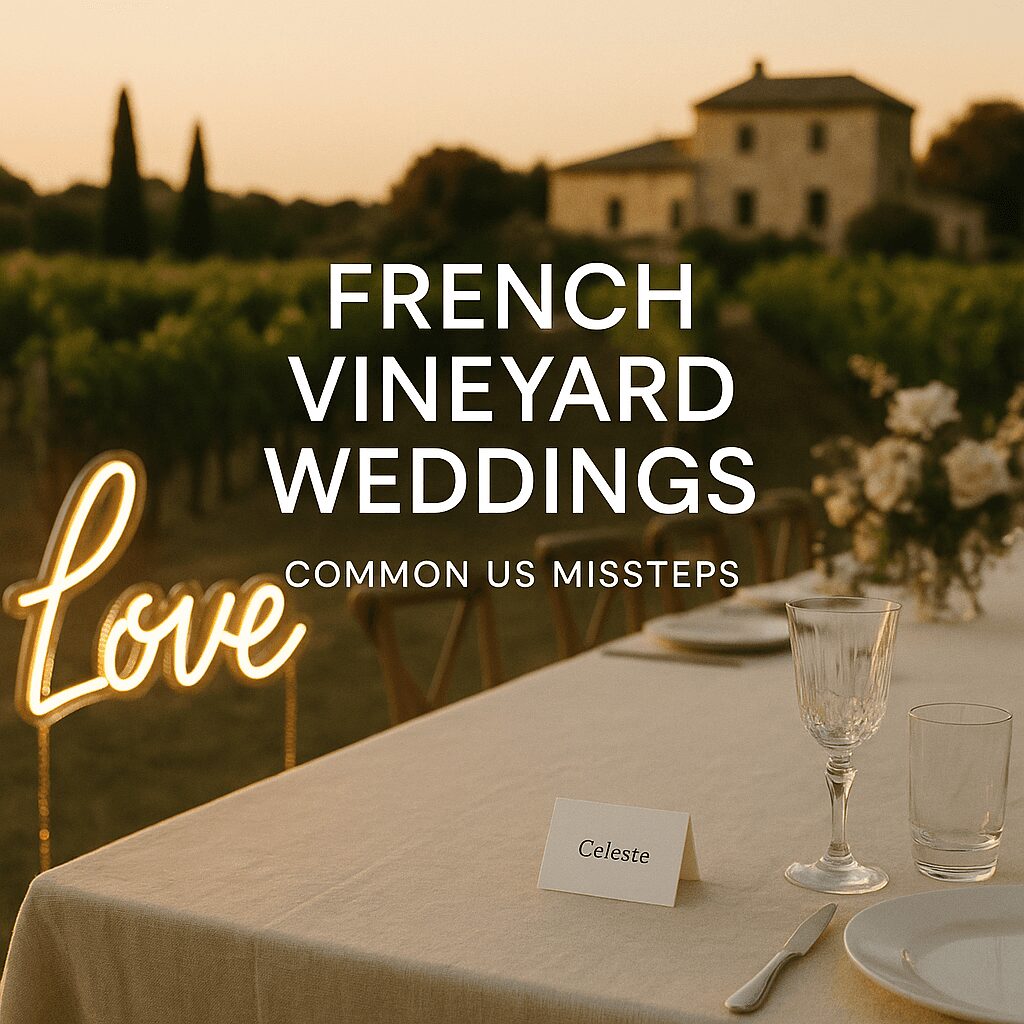
There's this idea a lot of US couples carry when they start planning a French vineyard wedding.
It's basically a movie.
A golden hour ceremony between endless rows of vines. A long rustic table. Linen napkins fluttering in the breeze. Everyone drinking wine like it's water. No stress. No logistics. France just sort of… handles it.
And look, the vibe is real. French vineyards can absolutely feel unreal, in the best way. But the planning part? The cultural stuff? The assumptions people bring from US weddings?
That's where things get messy fast.
So here's a straight, practical breakdown of what US couples often get wrong about French vineyard weddings, and what to do instead so your day still feels magical, just without the silent panic.
1. Thinking "French vineyard wedding" means "small and simple"
In the US, destination wedding often translates to "smaller guest list, easier timeline, less stuff."
However, in France, a vineyard wedding can be intimate but it doesn't automatically mean it's simple. What you're really doing is hosting a multi-day experience in a place that has its own rules, rhythms, and vendors. If you privatize an estate (which many couples want), you are essentially taking over a small hospitality property for a weekend.
That means:
- arrival logistics
- rooms and who sleeps where
- breakfast the next morning
- noise rules
- transportation for guests who do not drive in France
- weather backups that work with stone buildings and vineyards, not hotel ballrooms
A French vineyard wedding is often more like: "a private house party at a historic wine estate, but elevated." Which is amazing. Just not automatically easy.
What to do instead: treat it like a hosted weekend, not a single evening. Build a plan that includes arrivals, pacing, and downtime. A venue that offers full property privatization and accommodations on site will make this way smoother.
Subtle plug because it's relevant: Domaine de Vavril in Beaujolais is literally built around this model—full estate privatization, reception spaces, outdoor areas, plus on-site stays. If you want the wedding to feel cohesive instead of scattered across hotels, it matters.
If you're interested in exploring how other US couples have successfully navigated their vineyard weddings in France, this link provides some insightful stories.
Additionally, if you're considering when to plan your vineyard wedding for optimal weather and scenery, this seasonal guide could be quite helpful.
For those leaning towards an intimate celebration rather than a grand affair, this article offers valuable advice on planning micro-weddings in these picturesque settings.
Lastly, if you're an American couple looking for practical tips on [planning your intimate French vineyard wedding from America](https://vavril.fr/en/planning-your-intimate-french-vineyard-w
2. Assuming French vineyards are near Paris (or "close enough")
This is the big one.
A lot of US planning starts with: "We'll fly into Paris, do a couple days, then the wedding is like an hour away."
Sometimes that's true. Usually it's not.
French wine regions are spread out. Burgundy, Beaujolais, Loire, Provence, Bordeaux, Champagne, Alsace. Each has a totally different feel. And "vineyard wedding" is not one location.
Also, French driving time hits differently. Narrow roads, small villages, roundabouts, jet lag, and guests who may not want to rent cars at all. A two hour drive can feel like six when you're coordinating ten couples, luggage, and a rehearsal dinner.
What to do instead: pick your region first, then plan travel realistically.
Beaujolais, for example, is a sweet spot for a lot of US couples because it's scenic and wine focused but also practical. You get vineyard views, stone villages, and access via Lyon (a major city with a solid airport and train connections). That's one reason venues like Domaine de Vavril work well for international groups; it's not "in the middle of nowhere." It's countryside, but reachable.
3. Expecting the venue to operate like an all inclusive US wedding barn
This is where a lot of frustration happens.
In the US, many venues sell an all inclusive package that basically includes everything except your dress.
In France, especially at private estates like Domaine de Vavril, the venue often provides the property, spaces, accommodations, and trusted partners. But not always a single bundled "wedding factory" experience.
And frankly, that can be a good thing. Because it means your wedding is not forced into one template. But it does mean you need to understand what is included and what is coordinated by you, your planner, or the venue's team.
Also, French venues can be more protective of the property. Historic buildings. Wine cellars. Gardens. Noise rules. Neighbor respect. Stuff like that.
It's not "they're being difficult." It's just… the place is real, and it has a life outside your wedding day.
What to do instead: ask clear questions early:
- What does privatization include?
- What time can vendors access the site?
- What is the music cutoff and where can music happen?
- What furniture is included?
- Is there an on site coordinator? Or do we need a planner?
- Do you have preferred vendors and why?
A good venue will answer without vagueness. And if they have partner vendors listed, that's usually a sign they've tested them under real event pressure.
If you're considering a unique experience in France's stunning landscapes while having your wedding at a [château](https://
4. Over designing the day and under designing the guest experience
This one is subtle.
US weddings often prioritize the visual details. The arch, the signage, the custom napkins, the twelve moment timeline.
France tends to prioritize the experience at the table.
Long meals. Conversation. Good wine. Breathing room. Less frantic "now we do the thing" energy.
When US couples bring an American minute by minute structure into a French vineyard setting, it can feel weirdly tense. Like everyone is trying to sprint through something that was meant to be savored.
And vineyards especially, they're calm. They're slow. The landscape almost demands a slower pace.
What to do instead: plan the flow like a weekend in wine country, not like a stage production.
Think:
- welcome drink that turns into conversation
- ceremony that is short and emotional
- cocktail hour that actually lasts long enough for people to enjoy
- dinner that feels like a long table feast, not a rushed service
- dancing later, after everyone has eaten properly
If you want the photos to look cinematic, give the day room to breathe. Seriously. Rushing makes everything look stressed.
5. Thinking you can skip transportation planning because "everyone will Uber"
This is the most common practical mistake.
In many French wine regions, rideshare is inconsistent. Late night rides are unreliable. Taxis may need to be booked in advance. And guests who drink should not drive, obviously, but they will if you leave them no other option.
Also, if your venue is on a vineyard estate, it's probably not on a city grid with easy pickup points.
What to do instead: budget for group transport.
Even if you do not cover it fully, at least organize it. A shuttle loop from a nearby hotel cluster or transport from a train station can be very helpful.
If you're considering an elopement in French wine country, planning for group transport becomes even more essential as it allows guests to fully immerse themselves in the experience without worrying about logistics.
If you choose a venue with on-site accommodations, you reduce the transport problem immediately. That's another reason estate privatization works so well: some guests can walk to bed, which is honestly the dream.

Additionally, consider looking into all-inclusive elopement packages in French wine country. These packages often include transportation as part of their offerings which can significantly ease your planning process.
However, if you're working with a tighter budget, there are still budget-friendly elopement ideas in French wine country that can provide an unforgettable experience without breaking the bank.
6. Underestimating how late French dinners start (and how long they last)
American weddings often have a tight schedule: ceremony around 4, cocktail at 5, dinner at 6, and dancing at 7.
However, in France, this timeline can feel rushed, especially during the summer months when the sun sets later.
Dinners typically start later, the meal lasts longer, and the pacing is more relaxed. If you attempt to squeeze a traditional French multi-course meal into a strict American schedule, something is bound to go awry. Guests may become restless, the kitchen might feel pressured, or the dance floor could open while people are still savoring their cheese.
What to do instead: Align with local rhythm.
While you don't have to adhere strictly to a "full French wedding structure," it's wise to embrace local customs if you're hosting your wedding in France with French catering at a beautiful vineyard estate. This is an opportunity to let the culture guide your wedding plans.
A typical comfortable flow for a French wedding could be:
- Late afternoon ceremony
- Long cocktail hour
- Dinner that starts closer to 8 PM
- Dancing later in the night
- Maybe an after-party space if the venue allows
It's advisable to consult your venue and caterer about what works best in that region as they possess valuable insights.
To delve deeper into personalizing your wedding ceremony in the French countryside, check out this guide on how to personalize your wedding ceremony in the French countryside.
7. Assuming "wine country" means unlimited drinking with no consequences
While it's true that a vineyard wedding revolves around wine, it's still essential to remember that a wedding is not just about drinking. People need hydration, jet lag can affect guests' energy levels, and summer heat in vineyards can be intense. Moreover, French wine often has a higher alcohol content than anticipated because it's so easy to drink while you're distracted by the festivities.
Also bear in mind that vineyards are not clubs. Many estates have noise restrictions and safety concerns particularly around cellars, terraces, and outdoor stone steps at night.
What to do instead: Build in water and food like it's your job.
Here are some suggestions:
- Set up obvious water stations
- Provide substantial snacks during cocktail hour
- Arrange for late-night food if dancing continues into the wee hours
- Ensure there's shade available during hot weather
- Create comfortable seating areas outside of "the dinner chair"
The more comfortable guests are, the happier they'll be which will ultimately lead to a smoother event.
If you're considering hosting your wedding at one of the fairytale wedding venues in French vineyards, or comparing UK manor houses vs French vineyards, it's crucial to keep these points in mind for an enjoyable experience for everyone involved.
8. Thinking French weddings are automatically "more chic" so you can stop planning
This is the myth Instagram sells.
France is beautiful, yes. But chic is not automatic. Chic is decisions.
If you throw random Pinterest ideas into a vineyard setting without adapting them, it can look oddly disconnected. Like you imported a coastal Amalfi aesthetic into Beaujolais, and now it's confused.
Also, French venues have their own personality. Stone walls, old beams, courtyards, vineyard rows, maybe a cellar. If you fight it with decor, you lose.
What to do instead: let the venue be the design.
Pick a few strong choices:
- florals that match the landscape
- lighting that makes stone and vines glow
- table styling that is simple and intentional
If you're choosing an estate like Domaine de Vavril, you're already getting atmosphere. Use it. Do less, but do it better.
9. Not realizing how important language is, even if "everyone speaks English"
In France, in wedding settings, many vendors speak some English. Some speak excellent English. But not all.
And even when English is fine conversationally, contracts, technical details, setup notes, and timing can get complicated. A small misunderstanding can cause a big day of stress.
What to do instead:
- Hire a planner who is bilingual, or at least experienced with international couples in France.
- Ask for written confirmations in clear terms.
- Keep your instructions simple and specific.
- Avoid slang in important communications.
Also, if you are doing vows or ceremony elements in English, consider including small French touches for local staff, family, or friends. Even a short bilingual welcome can feel thoughtful.
10. Assuming the legal marriage part is easy in France
This is a quick reality check.
Getting legally married in France as non-residents can be complicated, sometimes not possible depending on your situation and timelines.
Many US couples do the legal ceremony in the US (or at a courthouse before leaving), then do a symbolic ceremony in France. Which is what most guests care about anyway.
What to do instead: decide early whether France is symbolic or legal.
Symbolic weddings are common in France for destination couples. And they're often more relaxed because you're not tied to administrative constraints.
11. Overlooking weather plans because "it never rains in summer"
It rains. Sometimes it rains hard.
And vineyard weather can be unpredictable. Hot afternoons, sudden storms, cooler nights. Wind. Bugs. The whole nature package.
US couples sometimes plan a fully outdoor wedding with no real backup because they're emotionally invested in the vineyard ceremony. Which I get. But you need a Plan B that still feels beautiful, not a sad folding chair scramble.
What to do instead:
- choose a venue with indoor spaces you actually like
- ask to see rain layouts
- think about guest comfort: shade, fans, wraps at night
- consider floor options for outdoor dinner if the ground gets soft
A good estate will have multiple spaces that can flex. That's part of what you're paying for.
For those who still want to embrace the beauty of an outdoor vineyard wedding despite the potential weather challenges, there are some stunning outdoor vineyard wedding ideas for every season. These suggestions can help ensure that your dream wedding remains beautiful and memorable, regardless of the weather.
12. Trying to DIY everything from another continent
In the US, DIY is normal. People build signage, assemble favors, make welcome bags at 1 am, and it weirdly becomes part of the culture.
In France, especially for destination weddings, heavy DIY is usually more trouble than it's worth.
Because you're flying. You have luggage limits. You don't know where to buy materials. You don't want to spend your first day in France hunting for acrylic signs and ribbon.
Also, many venues do not want sticky hooks on stone walls or last minute crafts in historic rooms. Fair.
What to do instead: simplify and outsource the pieces that cause stress.
- Let the venue and planner recommend vendors.
- Use local rentals.
- Do fewer personalized objects and more meaningful experiences.
Guests will remember the wine in the courtyard and the way the light looked on the vines. They will not remember the custom itinerary card stock.
13. Not understanding that French service style is different (and it's not "worse")
This one causes quiet resentment sometimes, so let's just say it plainly.
French hospitality is not the same as American hospitality.
In the US, staff often checks in constantly. Refills, interruptions, "Hi my name is". In France, good service is often more discreet. Less hovering. More letting you enjoy.
US couples sometimes interpret this as slow or inattentive, when it's actually just a different rhythm and expectation.
What to do instead: communicate your priorities ahead of time.
If you want a faster cocktail service, say so. If you want water poured more actively, say so. If you want speeches between courses, say so.
But also, allow the French style to be what it is. It pairs well with vineyard weddings which are known for their estate-style charm. It's calmer.
14. Thinking the wine will just "be handled" without choices
It's a vineyard. So yes, wine will be involved.
But wine at weddings still needs planning: quantities, styles, how it's served, when it's served, what guests are expecting, what the meal is.
If your venue is on a working estate with its own vineyard and wines, that's a huge advantage. You can build a wine story into the weekend with tastings, cellar moments, and pairing suggestions.
At Domaine de Vavril, for example, the vineyard and wine are part of the identity of the place, not just a backdrop. If you're choosing a wine estate, use that. Don't treat wine like an afterthought line item.
What to do instead: make wine part of the experience.
- welcome glass on arrival
- a simple tasting moment
- pairings during dinner
- a bottle in each room as a gift (if the venue allows and it fits your plan)
It feels personal, and it's very "France" without being cheesy.
The part nobody says out loud
A French vineyard wedding is not "easier" than a US wedding.
But it can be cleaner. More focused. More human.
Because when you stop trying to recreate an American wedding in France, and you start letting France be France. The whole thing clicks.
The vines, the slower dinner, the courtyard conversations, the way guests actually stay present because they are not being rushed through a production schedule.
That's the real magic.
If you are considering such an event, here are some valuable resources: check out our guide to vineyard wedding venue checklist, explore rustic vineyard wedding decor ideas, or find out about the best shots to request for vineyard wedding photography. And if you're transitioning from Napa to Beaujolais for your wedding, our guide will help you navigate that journey.
For those planning their weddings in Pennsylvania or other regions with vineyards, our comprehensive Pennsylvania wedding planning guide could prove invaluable.
If you want a French vineyard wedding that actually works, start here
If you're early in planning and you want a venue that fits what most US couples are really looking for (privacy, vineyard atmosphere, accommodations, and a setting that feels like a whole weekend, not a one night rental), it's worth looking at Domaine de Vavril in Beaujolais.
You can explore the estate, wedding options, photos, and contact the team for availability here: https://vavril.fr
And when you reach out, ask the practical questions. The boring ones. Those are the ones that protect the beautiful parts.
Because once the logistics are handled, you get to actually enjoy the vineyard. Not just pose in it.
If you're considering hiring a local expert to navigate these logistics and enhance your experience, you might want to read about the benefits of hiring a French wedding planner.
FAQs (Frequently Asked Questions)
What are common misconceptions US couples have about French vineyard weddings?
Many US couples imagine a French vineyard wedding as a simple, small event with no stress or logistics, like a movie scene with golden hour ceremonies and endless vines. However, in reality, these weddings often involve hosting a multi-day experience at a private estate with complex logistics such as arrivals, accommodations, transportation, noise rules, and weather backups. Treating it like an elevated private house party rather than just a single evening event is more accurate.
Are French vineyards for weddings usually close to Paris?
No, French wine regions are spread out across Burgundy, Beaujolais, Loire, Provence, Bordeaux, Champagne, Alsace, and others. Many US couples mistakenly assume the vineyard will be near Paris or within an easy hour's drive. In reality, travel times can be longer due to narrow roads and village layouts. It's best to pick your region first and plan travel realistically. For example, Beaujolais is popular because it's scenic yet accessible via Lyon airport and train connections.
Do French vineyard venues operate like all-inclusive US wedding barns?
French vineyard venues typically do not offer all-inclusive packages like many US wedding barns. Instead, venues such as Domaine de Vavril provide the property, spaces, accommodations, and trusted vendor recommendations but expect couples to coordinate details like catering and entertainment separately. This approach offers flexibility but requires more planning on the couple's part.
How should US couples plan logistics for a French vineyard wedding?
Couples should treat their wedding as a hosted weekend experience rather than just an evening event. Planning should include arrival logistics for guests (considering transportation options since many may not drive in France), accommodation arrangements on-site or nearby, scheduling downtime between events to avoid fatigue, noise regulations compliance, and weather contingency plans that fit the venue's unique setting.
Why is Beaujolais a recommended region for US couples planning vineyard weddings in France?
Beaujolais offers a sweet spot of scenic vineyards and stone villages combined with practical accessibility through Lyon—a major city with an international airport and train connections. This makes it easier for international guests to reach the venue without long or complicated travel while still enjoying the authentic countryside vineyard experience.
What are some tips for ensuring a smooth French vineyard wedding experience?
To ensure a smooth experience: choose a venue that allows full estate privatization with on-site accommodations; plan your region and travel realistically; treat the wedding as a multi-day hosted event including arrivals and downtime; understand that venues may not be all-inclusive so coordinate vendors ahead; anticipate cultural differences in logistics; and consider resources like Domaine de Vavril which specialize in facilitating these weddings for US couples.