
Seating Chart Tips When Your Wedding Guests Speak Different Languages
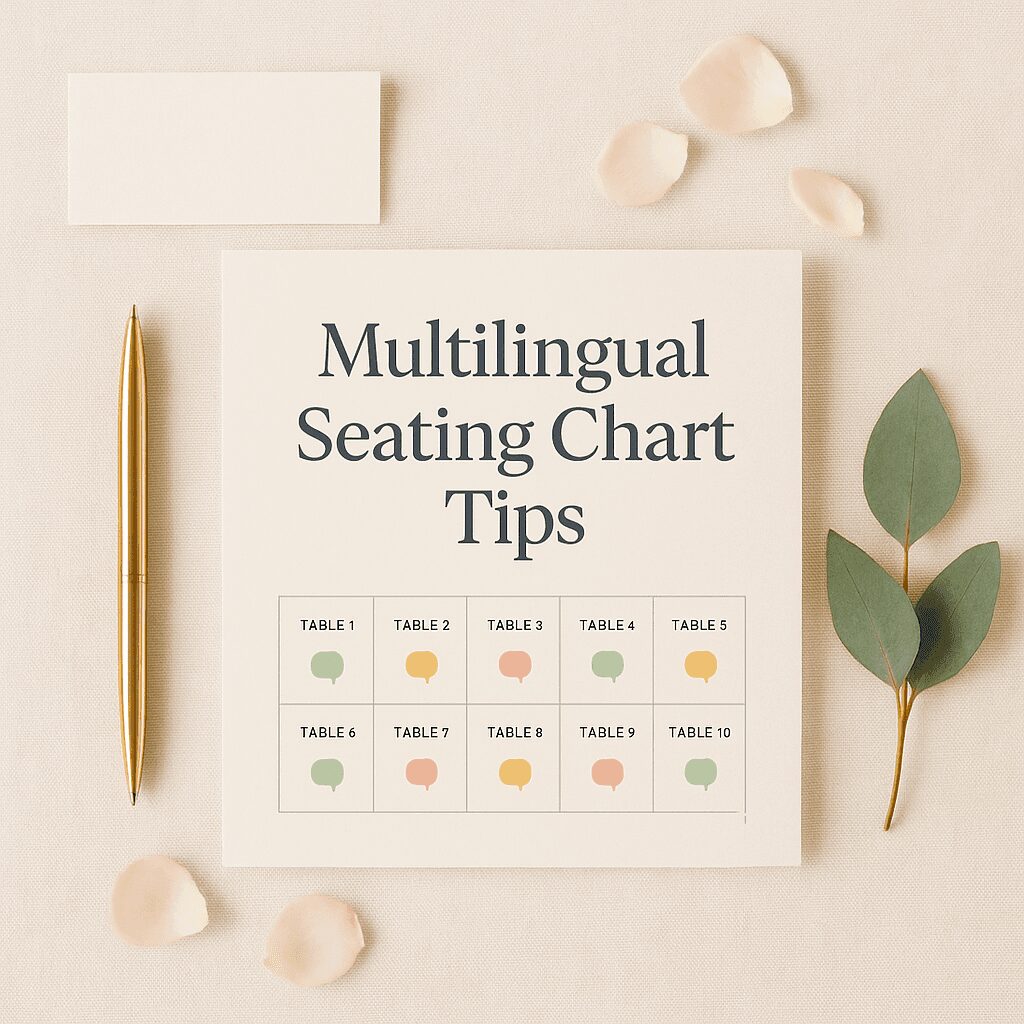
You do not really think about language until you are staring at a guest list that looks like an airport departure board. French on one side. English on the other. Maybe Spanish, Dutch, German, Arabic, Italian. A few people who are bilingual and a few who are… lovely, but will panic if you ask them to order coffee in the “wrong” language.
And then you remember the part where everyone has to sit together for hours.
The seating chart is where multilingual weddings can either feel warm and effortless, or a little awkward and isolating. The good news is, you can fix most of it with a few smart choices. Not perfect. Not forced. Just thoughtful.
Below are the seating chart tips that consistently work when your guests do not share a common language. Including a few small things that matter more than they should.
Start with one simple rule: nobody gets stranded
If someone shows up and cannot talk to anyone at their table, they will smile. They will be polite. They will suffer quietly. And you will only hear about it months later, if at all.
So make this your baseline:
- Every guest should have at least one person at their table they can comfortably speak with.
- If they are traveling alone, they should have two, honestly. One is not enough if that one person disappears to dance or smoke or help with speeches.
This is especially true for older relatives, shy friends, plus ones you have never met, and anyone who is already out of their comfort zone (destination weddings, first time in France, etc.).
Speaking of destination weddings in France, it’s essential to consider planning aspects such as the seating arrangements that align with your guests’ language preferences to create a more comfortable atmosphere for them. With careful wedding planning in France, you can ensure that every guest feels included and enjoys the celebration without any language barriers.
Moreover, leveraging vendor networks while planning for a wedding in France from abroad can simplify the process significantly. Lastly, considering an intimate wedding venue in France could also enhance the overall experience for both you and your guests by providing a more personal setting for your special day.
To further ease the multilingual aspect of your wedding, here are some planning tips for a bilingual wedding that could prove beneficial.
Map languages first, relationships second (just for a minute)
Normally, you build a seating plan around relationships. Family tables, friend groups, work friends. That still matters. But with multiple languages, do a quick language map first, then overlay relationships.
A simple way to do it:
- Make a spreadsheet with every guest.
- Add a column for “comfortable language(s)”.
- Add a column for “strong preference” if there is one.
- Add a column for “social energy” (quiet, medium, very social) if you know it.
It sounds a bit clinical. But you are not deciding who is fun. You are preventing the “I sat through dinner understanding 3 words” problem.
A note on bilingual guests
Bilingual people are gold. But do not use them like furniture.
One bilingual guest can help a table. They can not translate an entire wedding. If you place them between two groups who do not share a language, at least make sure the bilingual person likes that kind of role. Some do. Some absolutely do not.
Use the “bridge guest” strategy (and do not overdo it)
A bridge guest is someone who can connect two language groups naturally.
Examples:
- A cousin who speaks French and English and loves talking to strangers.
- A friend who lived abroad and switches easily.
- A couple where one is French, one is not, and they are both chatty.
The trick is to place bridge guests like anchors, not like translators on duty.
What works best:
- 1 bridge guest per table, sometimes 2 if the table is large (10 to 12 people).
- Keep them near the center of the table, not stuck at the end.
- Make sure they also have someone they personally enjoy talking with.
If you stack too many bridge guests at the same table, you create the “international table” that looks great on paper but can feel weirdly performative. Like a networking event.
While planning your wedding in France, consider personalizing your ceremony to reflect your unique love story, perhaps by exploring how to personalize your wedding ceremony in the French countryside. If you’re aiming for sustainability while maintaining luxury, check out these tips on planning a sustainable wedding at a luxury estate.
For those considering an authentic experience versus a commercial one, it’s worth looking into the differences outlined in this comparison of authentic vs commercial French wedding venues.
Budgeting for your vineyard wedding? This complete budget guide for French vineyard weddings could prove invaluable. And if romance is high on your agenda, don’t miss these insights on planning a romantic South of France vineyard wedding.
Consider language clusters, but keep them mixed at the edges
This is the part that surprises people. Fully mixing languages at every table is not always the best move. Sometimes it creates low level stress all night.
A better approach is often:
- Create soft language clusters (a mostly French table, a mostly English table)
- Then mix at the edges with a few bridge guests and a few adventurous people
So each table has comfort plus a little cross pollination.
This usually leads to more actual conversation, not less.
Put couples and close friends where they feel safe, then build out
If you have guests traveling from abroad, they are already doing a lot. New place, new schedule, maybe jet lag, maybe they are missing cultural cues. Give them social safety first.
Good placements:
- Next to people they already know
- Next to people with shared interests (wine, hiking, kids, music)
- Near a bridge guest, not separated across the table
You can still introduce them to new people, just do it gently.
Avoid the “singles table” in multilingual weddings
Even in one language, a singles table can feel like a punishment. In multiple languages, it can turn into a quiet disaster.
Instead:
- Spread single guests across tables where they share language with at least one person
- Pair them with friendly couples who are known to include people
- Place them near outgoing guests, not near a table of tight knit childhood friends who will talk in fast inside jokes all night
Seat older guests with extra care
Older guests often have the hardest time with language barriers. Also with noise.
A multilingual wedding dinner can get loud. People lean in, repeat themselves, switch languages mid-sentence, laugh, shout across the table. Fun, but tiring.
So if you have grandparents or older relatives:
- Keep them close to people who speak their language
- Avoid placing them at the “party table” near speakers or the bar
- Give them an easy exit route (not trapped in the middle)
They will stay longer. They will enjoy more. You will worry less.
Make your table sizes do some of the work
Smaller tables can be easier for multilingual conversation because the group can settle into one rhythm. A big table can split into mini groups and then the language divide gets sharper.
If your venue layout allows it, consider:
- Round tables of 8 to 10 for mixed languages
- Longer banquet tables when most guests share a language, with a few bridges spaced down the line
If you are planning a wedding at a place like Domaine de Vavril in Beaujeu, this is something worth discussing early because room configuration matters. The way a space flows, where the “center” is, how easy it is to move between tables. It all affects how often people actually mingle across languages.
Subtle plug, but real. Layout is not just aesthetics. It is social engineering, in the nicest possible way.
If you want to explore the ultimate checklist for organizing a destination wedding in Beaujolais, you can find valuable insights on planning your intimate French vineyard wedding from America here. Additionally, if you’re interested in understanding more about French wedding traditions, we have resources that can help.
For those considering a multi-day event at Domaine de Vavril, check out our guide on top activities for guests during such events. And for couples looking to incorporate winery elements into their wedding reception, we offer planning tips and ideas that could be beneficial.
Give people something to talk about that does not require perfect language
This is a big one. If conversation is hard, give guests shared anchors.
A few ideas that work without feeling like children’s camp:
- Family style sharing plates: passing dishes creates natural interaction.
- Wine on the table with a tiny note about the region: people point, ask, taste, react. This could tie into how to incorporate wine tastings into your wedding weekend.
- A photo on each table (of you as a couple, or of the region, or old family photos) with a little caption.
- A table name theme that invites easy questions. Places you have traveled, vineyards, songs, films.
If you are in the Beaujolais, you are basically sitting on top of a conversation starter already. People want to talk about the hills, the vines, the light, the taste of a wine they have never tried before. Use it.
Place your most expressive guests near the “mixed” zones
Not everyone needs shared language to connect. Some people communicate with energy, gestures, facial expressions, laughter, warmth. They are rare and wonderful.
Put those guests:
- At tables with mixed languages
- Near guests who might be shy
- Near the edges where two language clusters meet
They will make things easier without even trying.
Build one or two “reset tables” for later in the night
This is slightly unconventional, but it can save the vibe.
Sometimes, guests push through dinner in a second language, then later they just want to relax. If you can create lounge areas or high top tables where people can drift and find their language comfort zone, you get the best of both worlds.
This is less about the seating chart and more about the overall plan, but they connect.
At venues that have multiple indoor and outdoor zones, this is easier. A terrace, a courtyard, a side room, a cozy corner. If you’re considering unique ideas for outdoor wedding receptions in the vineyards, these areas could be perfect for creating that relaxed atmosphere. It gives guests freedom and allows them to enjoy your rustic vineyard wedding decor ideas while also having meaningful conversations.
Moreover, integrating some unique elements into your wedding reception can also enhance guest experience and provide more talking points.
Do not be afraid of one clearly labeled “international table” (if it is truly the right crowd)
I said earlier it can feel performative. That is true.
But sometimes it works brilliantly. The key is who you put there.
An international table works when:
- People are genuinely bilingual or comfortable in a shared fallback language (often English)
- They like meeting new people
- They are not easily embarrassed by misunderstandings
- They are not the people who need comfort and familiarity most
If you do it, commit to it. Put your most social bridge guests there. Make it the table that laughs the loudest. Not the table that quietly struggles.
Use escort cards that help without being cringe
You can support multilingual guests with small cues.
On escort cards or the seating chart sign, you can add:
- Flags or tiny language icons (subtle)
- A little “FR / EN” indicator for bilingual tables
- Table names that are easy to pronounce in multiple languages
Keep it elegant. No big “FRENCH TABLE” sign. People do not want to feel categorized.
Tell your DJ or MC which tables are mixed
If speeches or announcements are happening, your MC can help by:
- Speaking slowly
- Repeating key info in two languages when needed
- Avoiding private jokes only one group understands
You do not need full translation. Just awareness.
And yes, this matters at dinner because the room listens together. If half the room is lost during announcements, you feel the divide more.
However, for those planning a wedding with a significant multilingual aspect, consider hiring a professional who understands these dynamics. A French wedding planner could be invaluable in navigating these challenges effectively.
The head table question (and the sweetheart table solution)
If you are doing a traditional head table, it can become an intense language split because your closest people might not share a language.
Honestly. A sweetheart table can make this easier. It frees you to seat your VIPs where they fit best, instead of forcing a mixed language lineup right beside you.
If you do want a head table:
- Seat bilingual friends at the center
- Keep couples together if possible
- Avoid placing a single guest stuck between two groups
A quick sanity check before you lock it in
Before you print anything, run through these:
- Can every guest speak comfortably with at least one person at the table?
- Did you accidentally put all bilingual guests at the same table?
- Did you place shy guests at a table full of loud fast talkers in a language they do not speak?
- Are older guests seated where they can hear and participate?
- Are you relying on one person to translate for 8 people?
If the answer is “yes” to the last one, reshuffle.
One last thing, you can set the tone before dinner even starts
Seating charts do a lot, but the mood you create earlier matters too.
If cocktail hour is relaxed and mixed, people arrive at dinner already familiar. Even if they only exchanged smiles and simple phrases. That makes sitting down less intimidating.
So if you can:
- Encourage mingling with open space and good flow
- Keep background music at a level that allows conversation
- Introduce a few key people across groups early (quietly, not like a formal introduction)
By the time they reach the table, the room feels like one wedding, not two groups.
Incorporating Unique Themes
Consider adding some unique elements to your wedding to make it more memorable. For instance, stunning outdoor vineyard wedding ideas can provide an enchanting backdrop for your special day. Additionally, planning wine country wedding guest activities and entertainment could enhance your guests’ experience and make your wedding truly unforgettable.
Wrapping it up
A multilingual seating chart is not about perfect mixing. It is about comfort, dignity, and giving people a fair shot at having a good time.
Use bridge guests. Avoid stranding anyone. Let some tables lean more French or more English if that is what makes conversation real. And build a layout that helps people move and mingle, which is something a venue team can genuinely help you think through.
If you are planning a wedding weekend in the Beaujolais and want a place where guests can naturally circulate between dinner, terraces, gardens, and late night corners, you can take a look at Domaine de Vavril. This intimate French wedding venue offers such an experience.
Because sometimes the best seating chart tip is… give people space to breathe, then they do the rest themselves.
Additionally, if you’re considering a vineyard for your wedding, it’s essential to know what to look for. Check out this vineyard wedding venue checklist for some helpful insights.
Lastly, if you’re contemplating hosting your wedding abroad, make sure to read this guide on how to choose the perfect wedding venue abroad.
FAQs (Frequently Asked Questions)
How can I ensure all guests at a multilingual wedding feel included during seating arrangements?
Start with the simple rule that nobody should be stranded. Every guest should have at least one person at their table they can comfortably speak with. For guests traveling alone or those out of their comfort zone, it’s best to seat them with two people who share a language to avoid isolation.
What is the recommended method for organizing seating charts at weddings with multiple languages?
Begin by mapping out your guests’ comfortable languages before considering relationships. Create a spreadsheet listing each guest’s comfortable language(s), any strong preferences, and their social energy level. Then overlay this information with relationship groups such as family and friends to create thoughtful seating arrangements.
How should bilingual guests be incorporated into multilingual wedding seating plans?
Bilingual guests are valuable as bridge guests but should not be overburdened as translators. Place them where they can naturally connect language groups if they enjoy that role, but ensure they also have someone they personally enjoy talking with to avoid making them feel like furniture or on translation duty.
What is the ‘bridge guest’ strategy in multilingual wedding seating, and how is it effectively implemented?
A bridge guest is someone fluent in multiple languages who can connect different language groups naturally. Use one bridge guest per table (or two for larger tables), seat them near the center of the table, and ensure they have personal connections there. Avoid stacking too many bridge guests at one table to prevent creating an awkward ‘international table’ atmosphere.
Why is it important to consider language preferences when planning a destination wedding in France?
Considering language preferences helps create a comfortable atmosphere for all guests by minimizing language barriers. Thoughtful seating arrangements aligned with guests’ languages ensure everyone feels included and enjoys the celebration, which is especially important in destination weddings where guests may be out of their comfort zones.
Are there additional tips for enhancing multilingual weddings beyond seating arrangements?
Yes, beyond seating charts, you can personalize your ceremony to reflect your unique love story, consider sustainable luxury options for your venue, and leverage vendor networks when planning from abroad. These thoughtful touches contribute to a warm, effortless multilingual wedding experience.