
Bilingual Wedding Programs: What to Print for a Mixed Guest List
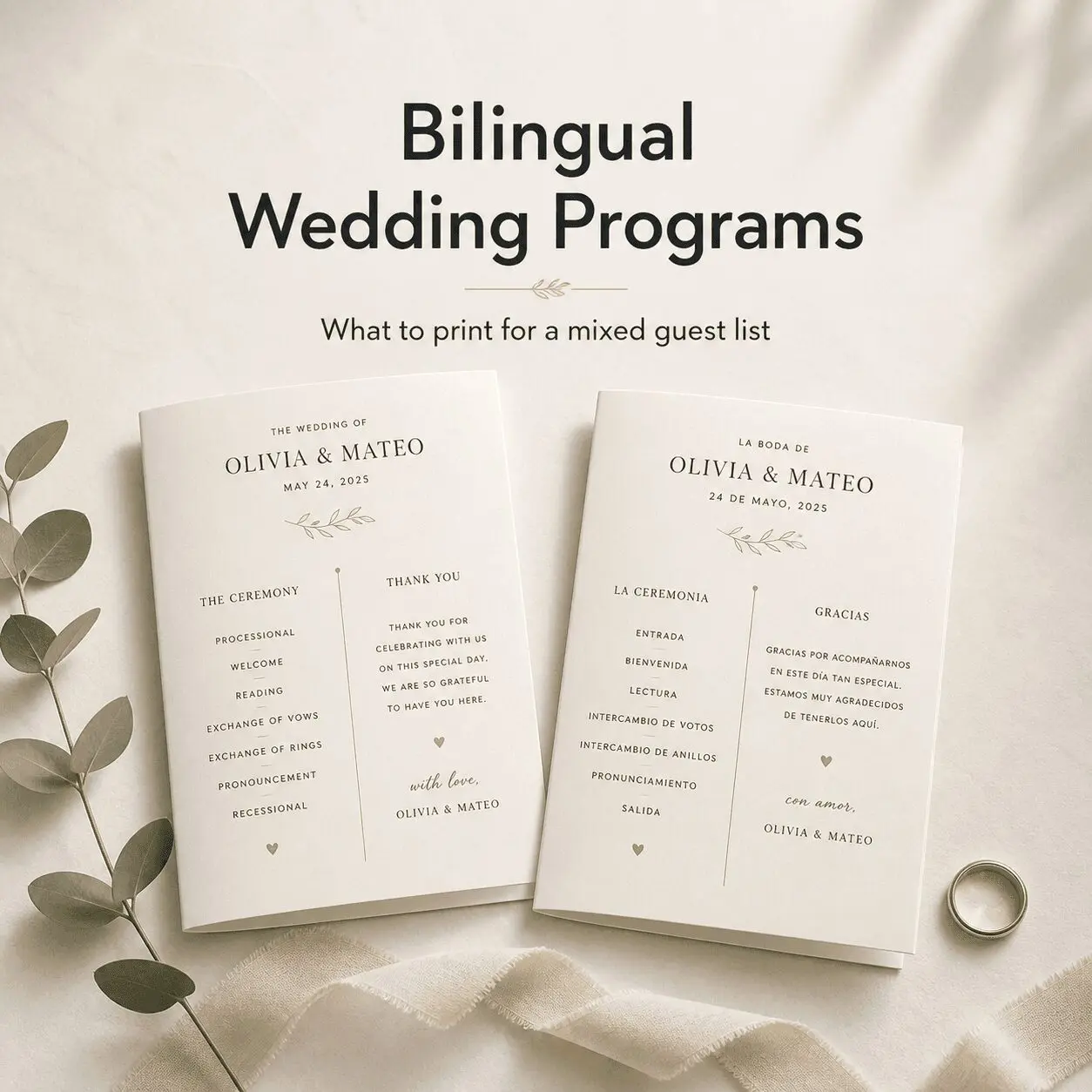
You only notice how many tiny questions guests have when you’re suddenly hosting people from two (or three) countries.
Where do we sit? What is this ceremony part called? When do we eat? Are we supposed to throw something? Why is everyone standing up right now?
A wedding program solves a lot of that. A bilingual wedding program solves it without making half your guests feel like they are… slightly lost, slightly behind, smiling politely.
And if you’re getting married in France with an international crowd (which happens a lot at Domaine de Vavril in Beaujolais), this becomes even more relevant. You might have French family who want the comfort of French. Friends flying in who are fine in English but not at 5 pm after travel. A few bilingual guests acting as translators all day, bless them, but still.
So let’s make this practical. What to print. What not to print. And how to keep it looking elegant instead of like a homework sheet.
First, decide what “bilingual” actually means for your wedding
There are a few common approaches. None are “correct”, it’s more about readability and budget.
Option 1: One program, two languages (side by side)
This is the classic. Same booklet or card, French + English on each section.
Best for:
- Truly mixed seating and mixed circles
- Catholic or civil ceremonies where structure matters
- Guests who will appreciate being able to follow along
Tradeoff:
- It takes space. You’ll write less. Which is not a bad thing.
Additionally, while planning your wedding at Domaine de Vavril, you might want to consider incorporating some local elements into your celebration. For instance, offering wine tours for wedding guests could be a delightful way to share the region’s rich culture and traditions with your international guests.
Option 2: Two versions (one French, one English)
Everything looks airy and clean. Each guest takes the version they need.
Best for:
- Clear split of guests by language
- When you want a premium, minimalist design
Tradeoff:
- You have to manage distribution. Also, couples often underestimate the “bilingual guest” who could pick either.
Option 3: One main language, with a short translation block
Like: French program, then an English summary at the end (or the other way around).
Best for:
- When one language is dominant
- When you’re trying to keep printing costs down
Tradeoff:
- The “summary” needs to actually be enough to follow the ceremony. Otherwise it’s just symbolic.
What to include in a bilingual wedding program (the essentials)
If you print nothing else, print these. This is the core of a program that helps guests relax and follow the day.
1) Names, date, and location
Sounds obvious. Still worth saying. Put it right at the top.
Example:
- Marie & James
- Samedi 14 juin 2026 | Saturday, June 14, 2026
- Domaine de Vavril, Beaujeu (Beaujolais)
If you have international guests, adding the region helps. People know “near Lyon” more easily than “Beaujolais” sometimes. Or they know Beaujolais and not Lyon. You can add both.
For those considering a destination wedding in Lyon, this can be particularly useful as it gives potential guests a better idea of where they will be traveling to.
2) A simple timeline (even for a ceremony program)
Guests love a timeline. They really do. Keep it tight:
- 15:30 Guests seated | Installation des invités
- 16:00 Ceremony begins | Début de la cérémonie
- 16:45 Cocktail | Vin d’honneur
- 19:30 Dinner | Dîner
- 22:00 Dancing | Soirée dansante
If your weekend includes multiple events (welcome dinner, pool day, brunch), a separate “weekend itinerary” insert can be a lifesaver. Especially at a venue that’s privatized for multi-day stays like Vavril, where guests are moving between spaces and days.
Incorporating wine tastings into your wedding weekend can also enhance the experience for your guests, especially considering the beautiful vineyards surrounding Beaujolais.
Lastly, if you’re considering hiring help for planning your wedding in France, you might wonder if hiring a French wedding planner is really worth it.
3) The ceremony structure (so people can follow along)
This is the main point of a program, and where bilingual matters most.
Include headings like:
- Processional | Entrée
- Welcome | Mot d’accueil
- Readings | Lectures
- Vows | Voeux
- Rings | Échange des alliances
- Kiss (yes, you can write it) | Le baiser
- Recessional | Sortie
For a religious ceremony, add the parts that guests might not recognize. For a civil ceremony in France, guests often appreciate knowing what is being read and why. You can find more about wedding planning in France to help with this.
4) The wedding party (optional, but popular)
If you include it, keep it readable. Names only, maybe roles.
“Witness” can confuse English speakers in a wedding context. In France, témoins are official witnesses. In English weddings, it’s close to “best man” and “maid of honor” but not identical.
You can write:
- Témoins (Witnesses): Claire Dupont, Ben Harris
Or: - Witnesses / Témoins: …
5) A short note about unplugged photos, confetti, or special moments
If you have rules, put them kindly, and in both languages.
Examples:
- Unplugged ceremony: Please keep phones away until after the recessional.
Cérémonie sans téléphone: Merci de ranger vos téléphones jusqu’à la sortie. - Confetti note: Dried flower petals only, thank you.
Confettis: Pétales de fleurs séchées uniquement, merci.
This avoids awkward announcements later.
For those planning their wedding from abroad, it’s worth considering vendor networks for a smooth experience. Also, having a complete wedding planning checklist can be incredibly helpful in ensuring nothing is overlooked during this important process.
What to print for a mixed guest list (beyond the ceremony program)
Here’s where couples can either overprint, or print smart. The key is: print what reduces friction.
1) Welcome note (printed, not just spoken)
Destination weddings especially need this. People arrive tired, they’re not sure what’s normal.
A small card in rooms or at a welcome table works well:
- Weekend schedule
- Wi Fi (if relevant)
- Emergency contacts
- Dress code reminders
- Local tips
If your guests are staying on site (Vavril has accommodation for group stays), a bilingual welcome card in each room is a nice touch. It makes the whole place feel intentionally hosted. You might also consider utilizing AI translation for hotels to make the welcome notes even more accessible.
2) Seating plan and table numbers (bilingual… but minimal)
You don’t need to translate “Table 6”.
But you might want:
- Plan de table | Seating plan
- Table des amis | Friends’ table (if you’re grouping)
Keep signage simple. Let names do the work.
3) Menu cards (high priority if food terms won’t translate easily)
Menus are one of the most appreciated bilingual prints. Because food vocabulary is where people get stuck.
If your menu is French (very common in France), translate it thoughtfully, not literally. Guests don’t need a dictionary, they need to know what they’re eating.
Example:
- Filet de bar, beurre blanc
Sea bass fillet with beurre blanc sauce - Suprême de volaille fermière
Free range chicken breast (farm raised)
Also: translate allergens clearly if you’re listing them.
4) Live translation setup
For weddings with a diverse guest list, consider incorporating live translation for wedding. This can significantly enhance communication during the event, making it more inclusive for all attendees.
4) Drink sign and bar menu (small but effective)
If you’re doing a cocktail hour with French terms, a small sign helps:
- Kir
- Spritz
- Vin rouge / blanc
- Eau plate / pétillante
It’s not about teaching French. It just reduces the number of “sorry what is that” interactions.
5) Weekend itinerary (if your wedding is multi day)
If guests are arriving Friday and leaving Sunday, print one clean itinerary page.
Include:
- Times
- Locations on the property
- What’s hosted vs optional
- What to bring (swimsuit for pool, jacket for evening)
At a venue like Domaine de Vavril, where you can privatize the estate and use different spaces over a full weekend, this one page becomes the thing guests refer to again and again.
How to format bilingual text so it’s actually readable
This is where programs fail. Not because of the content. Because of layout.
Keep translations paired, not separated
If you write the entire French section first, then the entire English section later, guests flip back and forth. Or they give up.
Better:
- Heading in both languages
- One short paragraph French, then English (or vice versa)
- Repeat
Pick a “primary” language for flow
Even in a side by side design, decide which language leads. Usually:
- In France, French first makes sense
- For mostly international guest lists, English first might feel kinder
Just be consistent.
Incorporating French wedding traditions into your event can also enhance the experience for your guests.
Don’t use tiny fonts to cram everything
A program is not a legal document. White space is part of the hospitality.
If you’re running out of space, cut:
- Long bios
- Too many thank yous
- Extra quotes
Or move details to a wedding website / QR code.
Common translation traps (and quick fixes)
Some wedding words don’t map neatly between French and English. Here are a few that cause confusion:
- Vin d’honneur: often translated as “cocktail hour” (accurate enough).
- Témoins: “witnesses” is correct, but you can also add “wedding witnesses” for clarity.
- Mairie: “town hall” works. “City hall” depends on the town.
- Cérémonie laïque: “symbolic ceremony” or “humanist ceremony”. Many couples just say “ceremony”.
- Dragées: “sugared almonds” (or “Jordan almonds”).
Also, be careful with tone. French programs sometimes sound more formal by default. English programs can be warmer or more casual. You can match them, but you don’t have to make them identical word for word. Same meaning, same vibe, that’s the goal.
How many programs should you print
You don’t need one per person. Usually:
- One per seat for the ceremony looks nice and avoids sharing
- Or one per couple if budget is tight
For bilingual programs, if you’re doing two versions, print a little extra of each. People grab the wrong one, or they want a keepsake.
Rule of thumb:
- 70 to 80 percent of guest count if one per couple/family
- 100 percent if one per seat
- Add 10 percent cushion
Remember, wedding programs for every guest can enhance the overall experience and should be considered carefully in your planning process.
Where to place them (so guests actually take them)
- Ceremony chairs or benches, placed before guests arrive
- A basket at the ceremony entrance with a small sign:
Programmes | Programs
If you’re doing two versions, label clearly:
- Français
- English
Simple. No one feels awkward.
Add a QR code, but don’t make it the whole plan
QR codes are great for:
- Translations of readings
- Longer explanations
- Weekend maps
- Song list
- Photo sharing link
But the program should still work without a phone. Especially if you’re aiming for an unplugged ceremony. Or if some guests simply… don’t want to scan things in formalwear. Fair.
A simple bilingual program template you can copy
Here’s a structure that works and stays compact:
- Marie & James
14 June 2026 | 14 juin 2026
Domaine de Vavril - Welcome | Mot d’accueil
- Processional | Entrée
- Officiant’s words | Mot de l’officiant
- Reading 1 | Lecture 1
Name - Vows | Voeux
- Rings | Alliances
- Signing | Signature (if applicable)
- Recessional | Sortie
- After the ceremony | Après la cérémonie
Cocktail location, timing, any notes.
That’s it. Clean, helpful, not overstuffed.
One last thing (that couples forget): your venue can help
If you’re planning a destination wedding in France, your venue team can be an invaluable resource. They can provide insights on what works best for mixed guest lists beyond just the obvious need for bilingual materials. They can suggest practical solutions such as optimal placement for programs, signage that guests might overlook, and timing adjustments when the day tends to drift.
At Domaine de Vavril, you have the advantage of a setting that naturally supports a weekend format. This privatized estate offers multiple spaces and accommodations for guests on-site. This unique setup allows your printed materials to serve a dual purpose; not only do they explain the ceremony, but they also help guests feel settled throughout their entire stay.
If you’re interested in exploring how a multi-day wedding could flow at this stunning venue, start by visiting https://vavril.fr. You can also find useful resources for planning your intimate French vineyard wedding from America, or discover how to personalize your wedding ceremony in the French countryside.
Additionally, if you’re looking for ideas on guest activities and entertainment during your wine country wedding, or seeking assistance from a professional wedding planner to organize your marriage, Domaine de Vavril has got you covered.
Suggested images to include in this post
Place these throughout the article where they fit best (intro, formatting section, menu section, signage section):
- A ceremony chair with a bilingual program on it
Alt text: Bilingual wedding program placed on ceremony chair - Close up of a bilingual menu card with French dish names and English translations
Alt text: Bilingual wedding menu card French and English - Welcome table with baskets labeled “Programmes” and “Programs”
Alt text: Wedding welcome table with bilingual program baskets - Seating plan board with a simple bilingual header
Alt text: Seating plan sign with French and English header - Small bar sign showing cocktails and translations
alt text: Bilingual wedding bar sign cocktail menu
If you have your own photos from the venue (or a styled shoot at Domaine de Vavril), those are even better. Real images always beat generic stock.
FAQs (Frequently Asked Questions)
Why is a bilingual wedding program important for international weddings in France?
A bilingual wedding program helps guests from different countries follow the ceremony without feeling lost or behind. It ensures that both French-speaking family members and English-speaking friends can understand the schedule and ceremony parts, enhancing their overall experience at your wedding in France.
What are the common approaches to creating a bilingual wedding program?
There are three common approaches: 1) One program with two languages side by side, ideal for mixed seating and ceremonies where structure matters; 2) Two separate versions, one in French and one in English, best for clear language splits and minimalist design; 3) One main language with a short translation summary, suitable when one language dominates and to reduce printing costs.
What essential information should be included in a bilingual wedding program?
At minimum, include: 1) Names of the couple, date, and location (including region details for international guests); 2) A simple timeline of events such as seating time, ceremony start, cocktail hour, dinner, and dancing; 3) The ceremony structure with headings like Processional, Welcome, Readings, Vows, Rings exchange, Kiss, and Recessional to help guests follow along.
How can I keep my bilingual wedding program elegant and not overwhelming?
To maintain elegance, avoid overcrowding the program with too much text. Choose an approach that balances readability with space—like side-by-side languages or a concise summary—and focus on essential information. Using clean design elements and limiting content helps prevent it from looking like a homework sheet.
Can I incorporate local elements into my wedding celebration at Domaine de Vavril?
Yes! Incorporating local Beaujolais elements such as wine tours for your guests can enrich their experience by sharing the region’s rich culture and traditions. This is especially appreciated during destination weddings in France with an international crowd.
How should I manage distribution if I choose to print two separate language versions of the wedding program?
When printing two versions—French and English—you’ll need to plan distribution carefully to ensure each guest receives the appropriate language. Consider your guest list’s language preferences ahead of time and possibly label or separate programs by language at seating areas to avoid confusion.